Imagine your small but fast-growing business, specializing in water bottles, lands a major bulk order from a top retailer. Excitement quickly turns to stress, because you’re on the verge of missing the deadline.
Why?
You just discovered you’re 500 units short on BPA-free caps. As it turns out, your sales data lives in one system, perhaps your ERP, and your inventory in another. Meanwhile, the production schedule is in a spreadsheet that hasn’t been updated in two weeks.
Enterprise resource planning (ERP) and material requirements planning (MRP) are two of the most important tools in operations management. The names may sound similar, but they’re built for different jobs. Confusing the two concepts can be a costly mistake.
In this guide, we’ll break down what each system does and help you decide which one your business should focus on first. By understanding how ERP and MRP work, and where their blind spots are, you’ll be better equipped to avoid costly mistakes and keep your growth on track, no matter your industry.
Quick insights:
- ERP vs MRP: ERP manages enterprise-wide operations; MRP focuses specifically on production and material planning.
- ERP improves cross-department visibility across finance, sales, procurement, and operations.
- MRP ensures materials are available by calculating requirements from BOMs and production schedules.
- Many manufacturers use ERP and MRP together for broader control and deeper production planning.
- Neither system alone delivers advanced demand forecasting or inventory optimization.
- Netstock enhances ERP and MRP systems with predictive forecasting, automated replenishment, and real-time inventory visibility.
What is an ERP system?
An ERP system is a centralized software platform that connects and automates core business processes across your organization. It acts as a single source of truth for multiple departments. Rather than a deep planning tool, it’s best understood as a system of record: broad in scope, unified in data, but limited in predictive capacity.
It’s important to keep in mind that there are hundreds of ERPs on the market, and each functions differently. While capabilities can vary by supplier and edition, a typical ERP system integrates:
- Finance
- Human resources
- Supply chain
- Manufacturing
- Sales
- Procurement
Because all departments share the same database, your team gets consistent, real-time information, no more manual data wrangling across disconnected systems. While this visibility is vital for your teams to know what’s going on in their departments, it only goes so far. ERPs aren’t designed for predictive planning or inventory optimization, so businesses often look elsewhere for those capabilities.
What is an MRP system?
MRP systems, by comparison, are specialized production and inventory planning tools used by manufacturers to ensure materials and components are available when needed. They also help reduce excess inventory.
MRP platforms calculate:
- What materials are required
- How many of each item you need
- When they must arrive based on the production schedule, current inventory levels, and bill of materials (BOM).
MRP helps manage production sequencing and purchasing decisions. They generate planned orders and align supply with demand forecasts. Because it focuses on manufacturing workflows, scheduling, and BOM processing, an MRP often provides more detailed operational planning than a broader enterprise system.
ERP vs MRP: key differences explained
| Category | ERP (Enterprise Resource Planning) |
MRP (Material Requirements Planning) |
| Primary Purpose | Manage and integrate core business processes across the entire organization | Calculate material requirements and align purchasing and production with demand |
| Scope | Enterprise-wide: finance, HR, supply chain, sales, procurement, manufacturing | Manufacturing-focused: inventory planning, BOM processing, and production scheduling |
| Primary Users | Executives, finance teams, HR, operations, supply chain managers | Production planners, buyers, inventory managers |
| Core Capabilities | Centralized database, cross-department reporting, financial management, automated workflows, transaction recordkeeping | BOM explosion, master production scheduling (MPS), purchase/work order generation |
| Data Requirements | Shared company-wide data model across departments | Inputs include BOMs, inventory records, and production schedules |
| Decision Focus | Strategic and cross-functional operational decisions | Tactical, production-level planning decisions |
In very simple terms, ERP systems integrate business functions on a unified platform. MRP systems focus on calculating materials and timing production.
Both ERP and traditional MRP systems rely on basic forecasting logic; neither provides advanced demand planning or inventory optimization out of the box. That’s where specialized solutions like Netstock come in, filling the gap with more sophisticated functionality.
Which system do you need? ERP vs MRP use cases
Ask yourself the following questions:
- Do you need BOM-level production control?
- Do you need cross-department financial visibility?
- Are you scheduling complex manufacturing runs?
- Do executives need real-time enterprise-wide reporting?
Let’s look at this through the lens of our water bottle scenario. The core problem for the hypothetical business is disconnected systems: sales data, inventory records, and production schedules don’t communicate with one another. ERP systems have been thoughtfully designed to eliminate this type of fragmentation.
An ERP system centralizes data across departments to provide teams with a shared database or source of truth; with ERP in place, the bulk retailer order would automatically update inventory levels and purchasing workflows. That makes it ideal for distributors or growing businesses that need company-wide visibility.
AN MRP system, on the other hand, would have calculated the cap shortage before production began. MRP compares inputs like BOM and inventory records with the master production schedule to determine what components are required and when. If 500 caps were missing, MRP would generate a planned purchase order.
In short:
- ERP solves the visibility gap.
- MRP solves the material planning gap.
- Using both ERP and MRP systems together makes sense for hybrid manufacturer-distributors.
Benefits of using ERP and MRP systems together
Most mature manufacturing or distribution businesses use ERP and MRP together because they solve different but complementary problems. The water bottle company illustrates exactly why:
Once the business lands a second major retail contract, the complexity multiplies. It’s managing multiple production lines, raw material suppliers, and fluctuating volumes across multiple SKUs.
ERP handles the organizational layer
Finance teams can see the revenue impact of both contracts, procurement can issue purchase orders, and leadership has a real-time view of cash flow.
MRP handles the operational depth
It calculates exactly how many BPA-free caps, labels, and lids are needed across both production runs and accounts, and accounts for current inventory levels. It next generates a sequenced purchasing schedule to prevent shortages.
Working in tandem, they can reduce (or eliminate) the fragmentation that caused the original missed deadline. Each one strengthens the other when connected; ERP feeds MRP with demand signals, and MRP can feed ERP with purchasing and production data.
ERP and MRP: Better together, but not without limitations
ERP and MRP systems improve operational structures, but they sometimes rely on static inputs and assumptions that create risk. Traditional MRP systems depend heavily on accurate BOMs, lead times, or master production schedules. If those inputs are outdated or incorrect, the outputs suffer.
In practice, teams that export ERP data into spreadsheets to manage forecasts or reorder points often experience manual errors or delays. That’s because basic forecast logic inside ERP/MRP environments often lacks AI-driven insights or predictive demand modeling.
Absent elements can lead to operational gaps that stall growing manufacturers or distributors: think excess inventory, stock-outs, and limited supplier performance visibility. These are exactly the kinds of issues that Netstock’s demand planning and inventory forecasting solutions can help address.
How Netstock enhances ERP and MRP performance
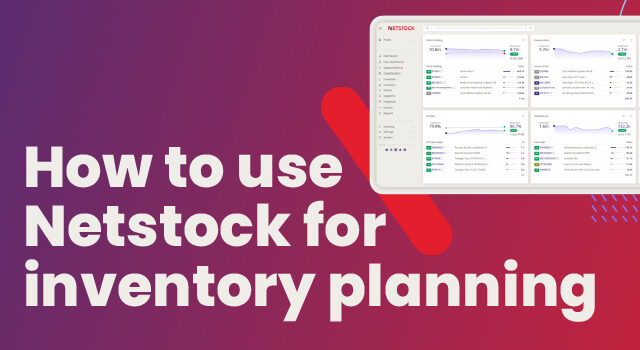
Netstock strengthens ERP and MRP environments by transforming static operations data into dynamic, predictive planning intelligence. Instead of replacing ERP or MRP systems, Netstock offers an AI-powered inventory and demand planning layer that integrates with your existing systems, enhancing visibility and decision-making.
While ERP provides centralized data visibility and MRP calculates material requirements, Netstock adds advanced forecasting, predictive analytics, and automated replenishment functionality. Its forecasting engine can help businesses generate accurate demand plans across products, channels, and regions. Moreover, the inventory optimization tools can unify inventory across sites and highlight stock imbalances. It can even recommend actions to reduce excess stock and stock-outs.
Returning to our water bottle example, Netstock would analyze historical sales trends, seasonality, and the new retailer to flag a projected shortage of BPA-free caps before production even begins. Instead of relying only on static lead times or outdated spreadsheets, planners would receive automated replenishment recommendations that align with real demand and supplier performance. This proactive visibility prevents missed deadlines and protects retailer relationships.
Additionally, Netstock’s inventory ordering automation streamlines replenishment workflows and recommends prioritized purchase or transfer orders that align with real demand. By making ERP and MRP data actionable and forward-facing, Netstock can help operations teams move from reactive planning to proactive decision-making.

Next steps: choosing the right system for your operations
Before investing in ERP, MRP, or an advanced planning layer, audit your current environment with the following questions:
- Are your sales, inventory, and finance systems disconnected?
- Do you manage complex bills of materials or multi-stage production?
- How accurate are your forecasts today?
- Are stock-outs or excess inventory affecting cash flow?
- Are teams relying on spreadsheets for planning?
ERP gives you cross-functional visibility. MRP brings structured production planning. But if you still face issues like forecasting gaps, spreadsheet overload, or inventory blind spots, Netstock can close the loop – delivering accurate forecasts, automated replenishment, and real-time inventory visibility, all built on top of your existing ERP data.