Every inventory team knows the frustration of having demand data and sales history, yet still struggling to make purchasing decisions because forecasts feel more like educated guesses than reliable insights. This persistent gap between data and confident decision-making is exactly where AI demand forecasting delivers the most value.
AI-powered demand forecasting isn’t just about quickly looking at past data. It can spot patterns in your sales and adjust for things like seasonality or unexpected changes. With this smart pattern recognition, your planning team can catch important signals that might otherwise go unnoticed.
The result? Your forecast updates automatically when conditions change, so you’re not relying on outdated information when it’s time to place an order.
This guide covers how demand planning has changed with AI, what better forecasting actually looks like in practice, and how businesses use it to reduce stock-outs and free up cash.
Key takeaways
- AI demand forecasting uses machine learning to analyze sales data and trends, then automatically updates predictions as new information arrives.
- Old forecasting methods struggle with real-world unpredictability, such as supplier lead-time variability, tariffs, and new product launches.
- AI forecasting works best for launching new products, managing large numbers of SKUs, handling unpredictable demand, planning across multiple locations, and setting safety stock levels.
- An effective AI forecasting tool should adjust to each product, detect unusual spikes or errors, track its own accuracy, inform ordering decisions directly, and explain why it made each recommendation.
- Netstock connects with over 60 ERP systems for real-time forecasting, helping SMBs save $40,000 to $200,000 and cut planning time in half.
Basic concepts to help demystify AI-driven demand forecasting
Before we get into the finer details of how businesses can leverage AI-powered demand forecasting, it’s helpful to unpack some basic concepts. Context is critical for decision-makers exploring modern demand forecasting and planning solutions.
What is demand forecasting?
Demand forecasting means estimating how much customers will want to buy in the future. By looking at past sales and market trends, you can make an educated guess about what you’ll sell. The goal is to plan for the right amount of stock, so you meet demand without over-ordering.
Back in the day, demand planners would rely on qualitative and quantitative demand forecasting methods. These traditional approaches work well in stable environments, with consistent demand and predictable supply networks. However, Netstock’s Benchmark Report proves that such stability is rare for SMBs operating with global supply chains.
For 68% of SMBs in 2025, the biggest supply chain headache is unpredictable supplier lead times. Throw in long waits and partial deliveries, and manual forecasting quickly becomes overwhelming.
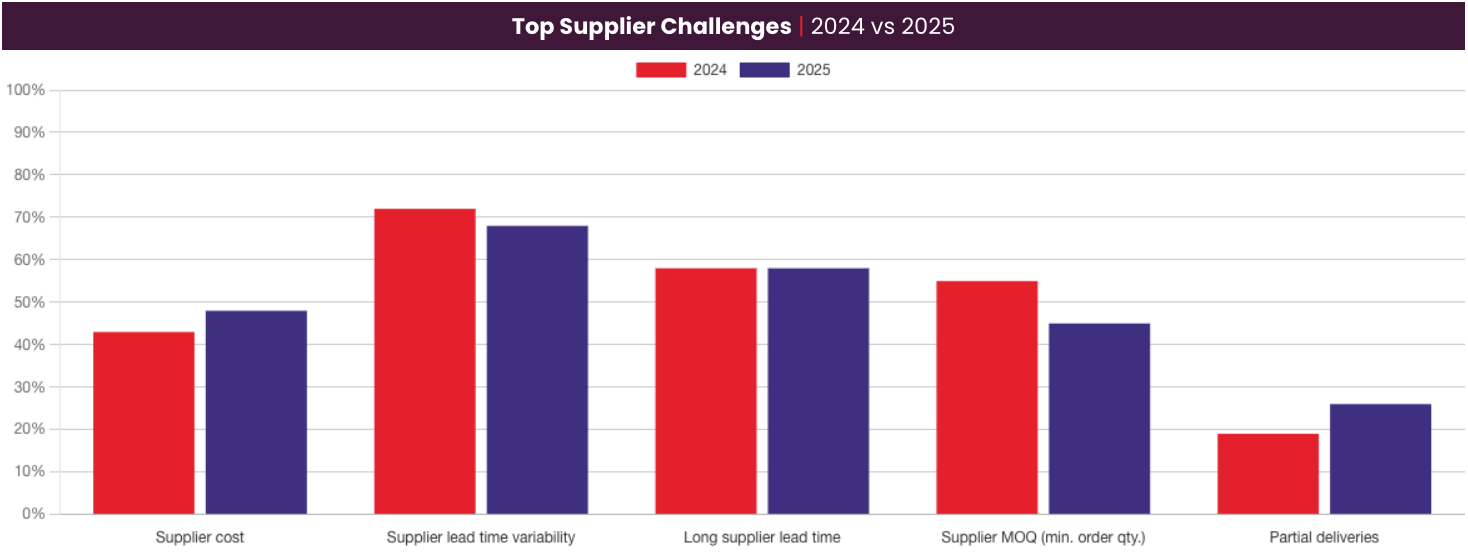
Promotions and customer demand shifts can further distort normal buying patterns, while seasonality varies by channel. All the while, 93% of SMBs that launched or expanded product lines 2025 had to forecast demand for new products without historical data to anchor their strategies.
All of these variables make it increasingly difficult to get accurate forecasts with traditional methods alone.
Why accurate forecasting matters
Accurate forecasting is the foundation of demand planning. It impacts every operation, from production planning to customer service.
| Accurate forecasts address critical areas of traditional demand planning processes | |
|---|---|
| Impact area | How accurate forecasts help businesses |
| Inventory management | Accurate predictions of future demand help businesses maintain optimal inventory levels, reduce carrying costs, and minimize stock-outs. |
| Cost control | With accurate forecasts, production schedules are better aligned with demand. Over time, this reduces the costs associated with overproduction or rush orders. |
| Customer satisfaction | Happy customers are good for business. Being able to meet customer demand on time enhances loyalty and stability. |
Definition: Real-time demand forecasting
Real-time demand forecasting uses current data to predict future customer demand. Unlike traditional methods that rely on historical data and periodic updates, real-time forecasting continuously integrates new data to deliver up-to-the-minute insights.
Why businesses move to real-time demand forecasting
Significant market changes can have immediate effects. In the face of volatility, supply chains must adjust in real time to successfully navigate the impact of tariffs and other disruptors. This approach to demand forecasting empowers businesses to stay agile, respond swiftly to shifts in consumer behavior, and remain competitive and efficient.
What is AI’s role in demand forecasting?
Traditional forecasting methods often struggle with the sheer volume and complexity of the data available today. AI does not. AI analyzes your data to deliver more accurate predictions.
Machine learning (a subset of AI) uses algorithms that learn from historical data to predict future demand. In demand forecasting, these algorithms continuously improve their accuracy by analyzing past sales data, market trends, and other relevant factors, adapting their predictions as new information becomes available.
They also identify patterns and trends that might be less obvious to human analysts.
AI demand forecasting uses machine learning algorithms to predict customer demand. Unlike traditional methods, AI-powered demand forecasting learns continuously from incoming data and improves its predictions over time.
For SMBs in a range of industries, solutions like Netstock’s AI are the inventory planning solution that improves the efficiency of your demand planning by:
- ensuring inventory levels are aligned with actual demand
- minimizing waste and carrying costs of expensive SKUs
- maximizing availability and reducing stockouts
Netstock’s inventory planning solution offers innovative demand planning that integrates machine learning into forecasting.
See Netstock’s demand and supply planning in action!

Benefits of AI in demand planning
The AI functionality in demand forecasting supercharges demand planning with accuracy and adaptability.
| Benefit | Business value |
| Cost reduction | With fewer forecasting errors, businesses can better balance inventory levels, so less working capital is tied up in slow or unmoving items. |
| Real-time adaptability | Real-time decision-making allows businesses to stay ahead of market shifts. |
| Improved decision-making | With AI-powered insights, businesses make more informed decisions. Netstock’s user-friendly interface gives stakeholders clarity when making strategic decisions. |
How does AI-powered demand forecasting work?
At the core of AI demand forecasting is a machine learning model trained on historical sales data. The true sophistication of the solution lies in what the model considers beyond the obvious.
Well-built AI forecasting engines will account for:
- Trend detection: Identifying whether demand for a product is growing, declining, or stable over time, and adjusting the baseline accordingly.
- Seasonality and cyclical patterns: Recognizing that a product spikes every Q4 or consistently slows in summer, and baking that pattern into the forecast rather than relying on a planner to remember it.
- Demand variability: Understanding that some SKUs are highly predictable while others are inherently volatile. Applying different forecasting logic accordingly.
- Outlier detection: Distinguishing a genuine demand spike from an anomaly caused by a one-time event, a data error, or a promotion. The model doesn’t build the wrong baseline into future forecasts.
- Zero-demand and no-demand handling: Correctly forecasting items with intermittent or sparse demand, which traditional models often mishandle by forecasting demand where none is expected.
- Promotions and events: Adjusting forecasts when planned promotions or seasonal campaigns are expected to influence buying behavior.
AI-driven demand forecasting processes these inputs continuously. When new sales data comes in, the model updates. Changes in lead time create adjustments to safety stock recommendations. If a product moves faster or slower than expected, the forecast reflects this development before a human needs to flag it.
Key use cases for AI demand forecasting
Theory is one thing, but the best way to understand how demand forecasting creates value is to look at where planning teams have already spent the most time (and where poor forecasts create the most damage).
New product launches
Forecasting demand for a new product is one of the hardest planning challenges. There’s no direct sales history to anchor on. AI-powered forecasting uses modeling to identify comparable products in your catalog and adjust their historical performance based on differences in price, channel, customer segment, or category. This gives planners a structured starting point rather than a blank page, and the model recalibrates quickly once real sales data starts coming in.
High-SKU environments
Businesses managing thousands of SKUs across multiple locations can’t realistically maintain individual manual forecasts for every item. AI demand forecasting automatically handles volume. It applies the appropriate forecasting model to each SKU based on its demand behavior, then flags exceptions that require human attention. This way, planners can save time by only prioritizing items that actually need a decision, rather than large catalogs of SKUs.
Volatile or unpredictable demand
Some categories are harder to forecast than others. Seasonal products, promotional items, and SKUs sensitive to external events or raw materials that can be impacted by tariffs are all examples where traditional models struggle. AI-powered demand forecasting adapts more quickly to changes in demand patterns, reducing the lag between a market shift and the corresponding adjustment to the forecast and replenishment plan.
Multi-location and omnichannel planning
Demand doesn’t behave the same way across every channel or every location. A product that sells consistently in one store might be slow-moving in another, while the same item flies online during a promotional campaign. AI-driven forecasting can model demand at the location and channel level. This allows planners to position inventory more precisely. Gone are the days of relying on a single blended forecast that underfits every individual context.
Safety stock and buffer optimization
Safety stock calculations are directly tied to forecast accuracy and lead-time variability. When forecasts are inaccurate, safety stock has to compensate. Businesses sometimes carry more inventory as insurance, but that only ties up capital. AI-driven demand forecasting reduces the uncertainty that drives excess safety stock, allowing businesses to maintain service levels with less cash tied up in buffer inventory.
Real-life examples of AI demand forecasting
Furnart is a prime example of a company that has successfully harnessed AI and demand planning to scale the business. By leveraging Netstock’s solutions for automation, real-time inventory visibility, and intelligent planning, Furnart’s lean team of eight can deliver big outputs in three countries, across 170 stores.
Client spotlight: Furnmart
Thirteen years ago, Furnmart, a major furniture retail group based in South Africa, had outgrown its manual processes. “When you have 20 stores, manual planning can still work. But once you start expanding beyond that, you simply can’t operate that way anymore,” said Tanya Pretorius, Merchandise Planning Manager.
To scale the business to what it is today, Furnmart chose Netstock. The AI-powered, scalable demand planning solution kept pace with the large-scale business growth while simultaneously improving the planning team’s speed and accuracy.
“The efficiency of managing hundreds and hundreds of product forecasts at a consolidated level, and having complete confidence that Netstock accurately disaggregates that demand down to each store for precise replenishment, is a transformational capability for the business.”
— Tanya Pretorius, Merchandise Planning Manager, Furnart
5 business benefits of AI-powered demand forecasting
The value of AI-powered demand forecasting reveals itself across different dimensions of business performance beyond simple forecast accuracy:
1. Reduced stock-outs and lost sales
When forecasts are more accurate, replenishment decisions align more closely with actual demand. Products stay in stock more consistently, reducing lost revenue and customer churn.
2. Lower excess inventory and carrying costs
Accurate AI demand forecasting reduces the tendency to over-order as a hedge against uncertainty. That means less working capital tied up in slow-moving or excess stock, and lower costs associated with storage, insurance, and potential markdowns.
3. Faster response to market changes </h3>
Because AI models update continuously rather than on a fixed cycle, planning teams can respond to demand shifts much earlier. A sudden spike or drop in demand shows up in the forecast (and in replenishment recommendations) before it becomes a service problem.
4. Less time on manual forecast maintenance
One of the least visible but most significant benefits is what AI demand forecasting frees planners from doing. When the model handles routine forecasting across thousands of SKUs, planners spend less time building and adjusting spreadsheets and more time on the decisions that actually benefit from their extensive professional and business knowledge.
5. Better financial outcomes
Inventory decisions are cash flow decisions. When forecasting accuracy improves, the downstream effects include healthier inventory turnover, more predictable ordering cycles, and fewer emergency purchases at premium freight costs.
Benefits of real-time data integration
What makes the business benefits of AI-driven demand forecasting possible is the ability to capture, track, and analyze real-time data.
Integrating real-time data into demand forecasting helps businesses unlock major benefits that directly translate into their operations.
| Benefit of real-time data integration | Business impact |
| Enhanced accuracy | Incorporating up-to-date information improves the precision of demand forecasts and reduces the risk of overproduction or stock-outs. |
| Improved responsiveness | Businesses can quickly react to market changes, such as sudden spikes or drops in demand. |
| Increased agility | Real-time insights enable companies to pivot strategies promptly. |
| Optimized inventory management | Accurate forecasts help maintain optimal inventory levels. |
Challenges in implementing real-time forecasting
While the benefits of demand optimization & planning software are clear, implementing real-time demand forecasting comes with a few challenges:
- Data integration complexities: Combining data from multiple sources in real time requires a robust IT infrastructure.
- Need for continuous updates: Maintaining data quality is essential for accurate forecasting.
- Investment in technology: Implementing systems can require significant investment.
To streamline implementation and mitigate potential challenges, businesses should make a dedicated effort to research AI demand and supply planning tools, rather than simply choosing the first option they come across.
What should AI demand forecasting software help you do?
Not all AI-powered demand forecasting capabilities deliver the same value. When evaluating solutions, there are a few indicators that separate genuinely effective forecasting from AI that’s mostly a marketing label.
| ✔ | Adapt by SKU | The best systems apply different forecasting models to different types of products based on their demand characteristics rather than using one approach for everything. Stable, high-volume items need different treatment than intermittent or lumpy SKUs. |
| ✔ | Detect outliers and anomalies | A forecasting system that can’t distinguish a genuine demand shift from a data error or one-off event will build noise into your baseline. Look for solutions that identify and handle demand outliers explicitly. |
| ✔ | Measure forecast accuracy | You can’t improve what you can’t measure. A strong AI-powered forecasting system should give you clear visibility into forecast error, ideally benchmarked against a baseline so you can see how much the AI is actually contributing. |
| ✔ | Streamline replenishment and safety stock | Forecasting in isolation isn’t enough. The forecast should flow directly into ordering recommendations, safety stock calculations, and replenishment planning. This way, improvements in accuracy actually translate into inventory decisions. |
| ✔ | Learn from planners | The best AI demand forecasting systems learn from planner input over time. When a planner overrides a forecast or adjusts a parameter, the system should capture that signal and incorporate it into future predictions. |
| ✔ | Deliver transparent forecasts and recommendations | Planners are more likely to trust and act on a forecast they can understand. Look for systems that surface not just the number, but the reasoning behind it. This makes it easier to validate and build confidence in AI-generated recommendations. |
How Netstock approaches AI demand forecasting
Netstock’s demand planning capabilities are built around the idea that AI should make planners more effective, but not completely replace their judgment.
This guides our approach to AI, which is:
- Built on quality data to ensure that recommendations are verifiable, relevant to your business, and trustworthy.
- Focused on real planning decisions that make the biggest impact today, unlocking $40,000 to $200,000 in value for SMBs.
- Designed to fit into your workflow, enhancing speed and cutting planning time by 50% – all without adding complexity.

The platform integrates with more than 60 ERP systems to pull live sales, inventory, and order data into a continuous forecasting engine. That data feeds AI-powered forecasting models that adjust dynamically.
For each SKU, Netstock’s AI selects and applies the most appropriate forecasting model based on demand behavior. It handles everything from high-volume stable items to intermittent and slow-moving stock.
Worried about outliers? AI automatically detects and accounts for them so they don’t corrupt your baseline. All the while, the engine leverages data-driven forecasts to recommend replenishment and ordering adjustments. While recommendations are curated through analysis and training, Netstock’s artificial intelligence lets planners have the final say in decision-making. Over time, the AI learns from how planners interact with recommendations, improving its outputs as more feedback is incorporated.
The result is a planning environment where AI handles the volume and complexity, and planners handle the judgment and decisions that drive better business outcomes.