The goal of inventory management is to have the right amount of inventory in the right place at the right time.
It means managing the flow of goods into and through the organization, balancing the risk of stock-outs with the cost of holding extra inventory.
Good inventory management supports sales through product availability, reduces waste, and frees up working capital. The reorder point Formula helps planners achieve this by showing when to replenish stock, using demand, lead time, and safety stock to reduce risk and keep operations steady.
This article explains how the reorder point Formula works, how to calculate it, and how modern inventory planning software helps automate and optimize across thousands of SKUs.
What you’ll learn
In this article, you’ll get a clear understanding of:
- What the reorder point formula is and why it matters
- How to calculate reorder points using demand, lead time, and safety stock
- When it’s appropriate to calculate reorder points without safety stock
- The difference between safety stock and reorder points, as well as how they work together
- Advanced methods for setting reorder points in variable or seasonal environments
- How modern software automates calculations to reduce stock-outs and improve service levels
What is reorder point?
Definition: The Reorder Point in inventory management is the minimum stock level you should maintain before placing your next order. It is sometimes referred to as ROP or even just “order point.” These terms are all interchangeable and used to describe the specific level or inventory that triggers the next purchase.
What it does: It sets a minimum level so you reorder before running out, ensuring you have enough stock while waiting for the next delivery.
What’s included in the formula: The reorder point Formula includes the lead time demand to cover sales over the supply period and safety stock to cover supply and demand variability.
A well-calculated reorder point ensures:
- You don’t cause stock-outs by reordering too late.
- You don’t tie up working capital by reordering too early.
Why is reorder point important?
ROP is important because it balances key cost drivers in inventory management.
- Inventory holding costs: These are costs for storing inventory, like warehouse space, insurance, and the risk of items getting old or spoiled.
- Stock-out costs: These include lost sales, extra shipping costs, and unhappy customers who may not return.
- Timely order fulfillment: Managing inventory holding and mitigating stock-out costs are crucial. A well-defined ROP helps by replenishing inventory before it runs critically low, minimizing delays in fulfilling customer orders. This proactive approach enhances operational efficiency, satisfies customer expectations, and strengthens relationships throughout the supply chain.
Benefits of using the reorder point Formula for efficient inventory management
| Business impact | How the reorder point delivers this benefit |
| Reduced holding costs | Avoid excess inventory by waiting for it to reach the calculated reorder point before reordering. Lower inventory releases investment capital and reduces the storage space you need. Insurance costs, interest, and damages will drop. |
| Minimized stock-outs | Ordering on time reduces the risk of stock-outs and lost sales, keeping customers happy. |
| Inventory ordering improvements | You can automate purchase orders, saving time and effort. Automated processes eliminate human error. |
How to use the reorder point Formula?
The basic reorder point Formula is:
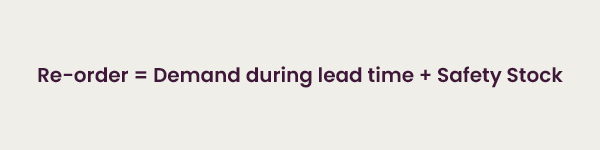
Where: The demand during lead time is the estimated sales during the time it takes to replenish the stock. For this, you need an accurate forecast.
You need three basic bits of information to calculate the reorder point.
- Average daily demand variability: Work this out by dividing the total sales by the number of days in the period.
- Lead time: The time it takes from the moment you place an order until the supplier delivers it.
- Safety stock: The extra inventory you need as a buffer in case of a delivery delay or a spike in sales. In the reorder point formula, safety stock accounts for demand fluctuations during the lead time and replenishment delays. The size of the safety stock will depend on demand variability and the reliability of supply.
The ROP triggers the next order and should balance your stock at the ideal level. The right inventory level balances the stock-out risk with the cost of holding surplus inventory.
Relationship between safety stock and reorder point
Safety stock and reorder points are closely related, but serve different purposes.
Safety stock is the strategic amount of excess stock businesses carry to reduce the risk of stock-outs. It’s based on historical demand variability, lead times, and its importance to the business.
In addition to reducing stock-out risk, safety stock buffers against other inventory disruptions, including:
- Demand spikes: Safety stock provides for sudden demand increases.
- Supply delays: Safety stock ensures you have stock if an order arrives late due to supplier or transport delays.
- Operational inefficiencies: Safety stock covers internal inefficiencies, like order placement delays and damage.
On the other hand, the reorder point is the trigger for placing the next order. ROP includes safety stock in its calculation to cover unexpected changes in supply or demand, but the two concepts are not interchangeable.
Reorder point vs. safety stock
| Concept | Purpose | When Used |
| Safety stock | Buffer against variability | Always recommended unless demand and lead time are extremely stable |
| Reorder point | Order trigger point | Always used as part of inventory replenishment planning |
Formula connection: Reorder point = Demand during lead time + safety stock
In a perfectly predictable world, safety stock wouldn’t be necessary, but for most SMBs, demand variability, supplier delays, and other operational realities make it critical.
Calculating reorder point with safety stock
There are multiple ways to calculate safety stock depending on the level of sophistication you’re looking for and your supply chain’s variability.
To pick the right method for your business, assess several factors, including:
- Demand variability
- Lead time variability
- Required service level
- Supply chain uncertainties
- Supplier performance
Basic safety stock formula
Using this formulation, a business holds a certain number of stock days beyond the ROP.
If a business wants to keep five days of additional stock, it will calculate its average demand over five days and set that as the safety stock level. Let’s assume their average daily demand is 200 units. Five days’ stock at average demand is 1,000 units, so they will set their safety stock to 1,000.
Calculating reorder point without safety stock
Safety stock is a vital part of inventory management, but it may not be necessary in some instances. If your business has the following, you may be able to calculate ROP without safety stock.
- Predictable demand and a reliable supply chain: Demand is stable, and your supplier has a reliable supply history.
- Just-in-Time deliveries: Businesses that use JIT aim to keep inventory at low levels. These businesses arrange frequent deliveries, using visual systems to replenish stock.
- Non-critical items: It may not be cost-effective to hold an extra stock of non-critical items.
- Perishable goods: A surplus of perishable goods could lead to high spoilage.
- Highly customized products: If the business tailors its products to customer requirements, it may keep component safety stock. Finished product safety stock would not be possible. Under such conditions, customers will wait for their customized products.
Where safety stock is not required, omit it from the inventory management reorder point formula. In low-risk environments, businesses reap the benefits of lower on-hand inventory.
Reorder point and safety stock examples
Two real-world examples show how ROP and safety stock work together:
Example 1: Bakery
- Product: Eggs
- Average Daily Demand: 200 eggs
- Lead Time: 5 days from order placement to delivery.
Reorder point Calculation
The bakery wants to avoid running out of eggs during the lead time. So, they establish a ROP to trigger a new order when inventory drops to a certain level.
Using a basic method:
- Reorder point (ROP) = Lead Time (days) x Daily Demand
- ROP = 5 days X 200 eggs/day
- ROP = 1,000 eggs
Safety Stock
The bakery knows demand sometimes spikes by up to 100 eggs per day. To ensure they have enough eggs to meet demand, they maintain a safety stock of 200 eggs.
How it Works:
- The bakery maintains an inventory level above the reorder point of 1,000 eggs most of the time.
- When the inventory level reaches 1,000 eggs, a new order is placed.
- The safety stock of 200 eggs is a buffer. If demand spikes during the lead time, the extra 200 eggs cover the additional needs while the bakery waits for the new order.
Example 2: Online electronics retailer
- Product: Laptops
- Demand: Variable demand depends on promotions and new releases
- Lead Time: 2 weeks (from order placement to inventory receipt)
Reorder point Calculation
Because of the high demand variability, the retailer uses more advanced methods to cover demand fluctuations. The retailer chooses an acceptable service level and uses the factor from the service level table.
Safety Stock
In this instance, the retailer is unwilling to risk lost sales and decides to maintain safety stock to maintain a 99% service level. They use historical data and statistical analysis to find the correct safety stock.
The retailer sets a ROP based on the calculated lead time and average demand with safety stock to support the desired service level. In this example, the safety stock is higher than in the previous example to support highly variable demand, and avoid lost sales.
Takeaways
- In both examples, the ROP triggers a new order to maintain baseline inventories.
- Safety stock is a buffer in both instances, but the amount and importance differ because of product characteristics.
- The safety stock level chosen depends on the item’s demand patterns, lead times, and business priorities.
Achieve your inventory objectives with reorder points
For years, ROP has helped businesses achieve their inventory objectives, supporting service-level goals with the least inventory. Managing and balancing inventories to support sales and optimize inventory is crucial for business success.
Improve your service levels, cash flow, and inventory holding costs. Release capital invested in inventory and use it to fund new projects and grow your business.
Disclaimer
All equations presented in this article use standard, commonly accepted formulas for illustrative purposes only and do not represent the specific algorithms or calculations used within the Netstock platform.