ABC classification has long been the backbone of inventory management. By ranking SKUs into A, B, or C groups, managers decide which items demand the most attention. But traditional methods rely heavily on spreadsheets or static ERP settings, which are time-consuming to maintain and can’t keep pace with today’s unpredictable supply chains.
AI changes everything about the process. Automating ABC analysis eliminates manual rework, adapts to shifting demand patterns, and ensures that planners are always focusing on the SKUs that matter most. The result? Faster workflows, fewer errors, and more confident decisions.
Key takeaways
- AI is the next evolution of ABC classification, proven by real-world examples.
- Automated inventory analysis saves time for busy inventory teams so they can focus on strategy, supplier relationships, customer satisfaction, and more.
- AI-driven accuracy improves SKU prioritization.
- Practical outcomes: better stock availability, reduced errors, smarter workflows.
- Netstock delivers fast implementation with minimal IT overhead.
What is the ABC classification system?
ABC classification is an organizational method used for decades by inventory planners. With this method, inventory is segmented based on pre-determined importance.
Typically, “A” items are the highest value or velocity SKUs, “B” items fall in the middle, and “C” items contribute the least. The goal is to allocate resources and attention where they matter most.
Essentially, the majority of resources and attention will be dedicated to group A. Typically, group A includes 20% of your total inventory. This 20% is responsible for 80% of your total sales.
ABC classification is a foundational practice for any inventory team. When automated with AI, however, this practice becomes far more powerful.
The limits of traditional ABC classification
For years, supply chain teams have relied on spreadsheets or static ERP rules to manage ABC categories. While this approach works at a basic level, it quickly shows cracks in fast-moving environments.
Manual classification requires constant updating. As SKUs multiply across categories and locations, the effort balloons. Human error creeps in, creating misclassifications that distort stock policies. A high-value SKU might accidentally be treated as low-priority simply because the data wasn’t refreshed.
Static ERP settings compound the issue. Rules are often fixed, ignoring seasonality, supplier variability, or sudden demand spikes. That rigidity means businesses are always a step behind. By the time reports highlight a problem, the damage is already done. Consequences come in the form of either excess stock eating into cash flow or shortages frustrating customers.
Traditional ABC analysis gives managers a starting point, but it struggles under modern pressures: complex SKU portfolios, shifting demand, and volatile lead times. Teams need a faster, more adaptive approach.
How AI transforms ABC classification
AI fundamentally changes how ABC classification is done. Instead of relying on static rules and periodic updates, AI continuously analyzes live sales, stock, and supplier data to ensure categories always reflect reality.
“The Netstock classification matrix and policy parameters have completely changed the way we look at inventory.” Steve Killworth, Operations Director at Select Hardware
Automated SKU classification
AI eliminates spreadsheet dependency by running classification in the background. High-value and fast-moving items are automatically flagged as priorities, ensuring managers never miss what’s critical.
This is especially important when classification changes on a dime. Customer demand is continuously shifting, so inventory does, too. Another time this might be beneficial is when a product or material is discontinued by a supplier. Instead of manually having to update each associated inventory item, the Netstock solution can make the large-scale change and re-segment stock accordingly.
Improved accuracy and adaptability
Machine learning is a programming model that uses algorithms as opposed to explicit training. ABC classification, on the other hand, has rigid training or rules. Machine learning models adjust for seasonality, demand volatility, and supplier lead times by learning from patterns. This reduces human error and ensures ABC categories remain relevant as conditions change. Categories aren’t frozen in time. Instead, they evolve dynamically with the market to reflect shifting priorities.
Time savings for inventory managers
Perhaps the biggest benefit of using AI for ABC classification is freeing up planners’ time. Instead of wrestling with data, planners can focus on high-level strategy: negotiating with suppliers, refining policies, and improving service levels. AI handles the repetitive work, delivering updated classifications without extra clicks.
In summary, AI-powered ABC analysis doesn’t replace planners – it empowers them. By handling the heavy lifting, it ensures managers can make better decisions faster.
Netstock’s AI-powered ABC analysis in action
As part of its AI pack, Netstock embeds AI directly into ABC classification, giving SMBs enterprise-level precision without needing a data science team.
Here’s how it works:
- SKUs are automatically classified by value, velocity, and variability using Netstock’s built-in classification algorithms
- Built-in dashboards highlight the SKUs that deserve immediate attention.
- Safety stock recommendations are dynamically adjusted based on an item’s classification and changing demand patterns.
- All data syncs seamlessly with the ERP, so there’s no double entry.
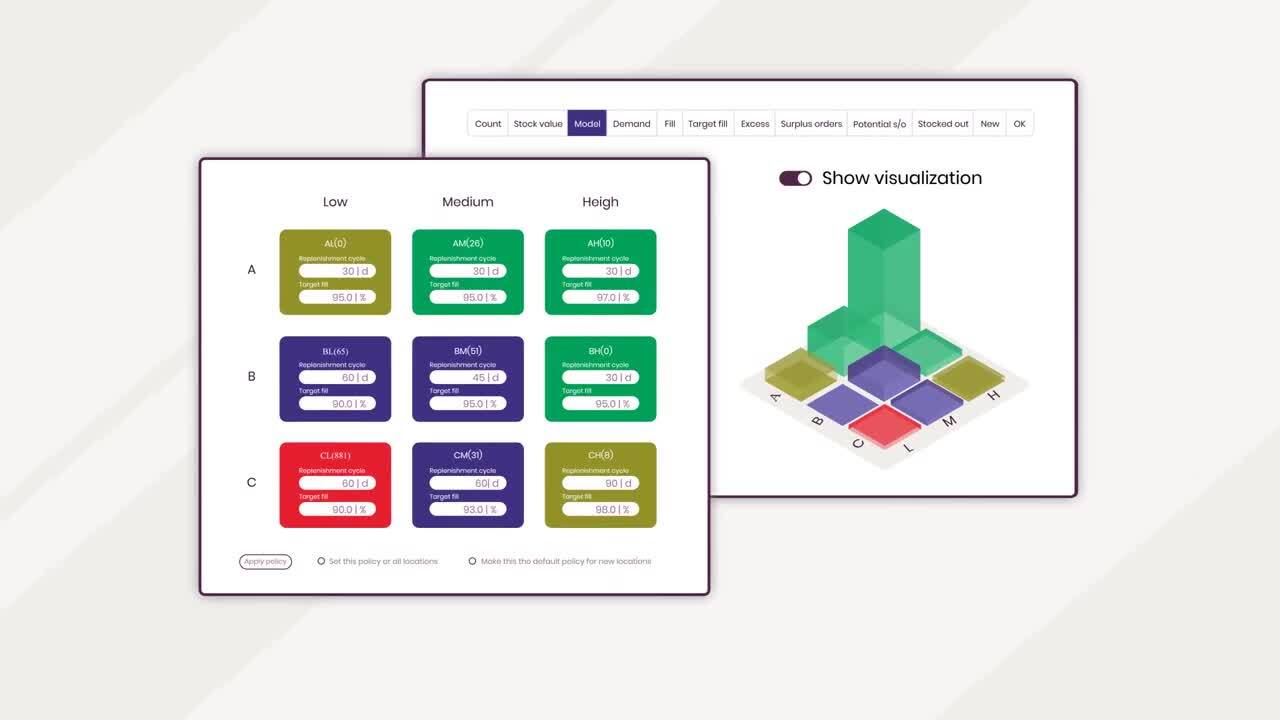
“Our ERP program used for purchasing was primarily based on quantity for classification, but that provided only one perspective. Using the Netstock classification matrix for both sales value and velocity, we can quickly determine the revenue impact of a potential stock-out on the horizon. If it’s on an AH (high value, high volume) item, we can act before it becomes a problem. Classifications also mean that we can focus our attention on our high flyers and no longer waste time on the low-value, low-volume items.” Bob Hollman, Vice President of Operations at LMC Truck
Implementation is straightforward. With guided onboarding, teams are up and running in weeks, not months. Netstock integrates with 60+ leading ERP systems, so you don’t have to worry about duplicate or missing data. Once live, the system runs in the background, automatically refreshing classifications and updating dashboards.
This automation makes classification not only faster but also smarter. Planners no longer need to guess whether their policies match reality. They can see, at a glance, where to act. And because it’s purpose-built for SMB supply chains, Netstock delivers these capabilities without the complexity of traditional BI or AI projects.
Real outcomes from AI-powered inventory management and classification
Automation isn’t just good for reducing manual admin time inside your business. It drives measurable results that impact your bottom line.
Consider a few examples:
- A regional distributor saves five hours weekly after eliminating spreadsheet updates, redirecting that time toward supplier negotiations.
- A manufacturer avoids costly expediting by catching SKU shifts earlier, cutting emergency orders in half.
- A retailer improves fill rates across locations by ensuring “A” items are always in stock while trimming excess from slow movers.
With ROI typically realized within months, automated ABC classification proves that small changes in process can unlock big gains.
These examples aren’t just hypothetical. They’re based on real experiences like the ones Bargreen Ellingson has had since implementing AI at their business.
With Netstock AI, Bargreen has been able to:
- Reduce holding stock from $17.8M to $9.3M
- Eliminate more than $2M in excess inventory
- Improve fill rates by 5% on high-turn items
- And more!
Why Netstock is the smart choice for AI-driven inventory classification
Not all AI is created equal. Many solutions promise automation but lack the industry-specific focus that inventory teams require. With more than 15 years of experience in the supply chain industry, Netstock’s AI is purpose-built for supply chains, designed to fit directly into planners’ daily workflows.
- AI built for inventory management: not generic analytics retrofitted for supply chains
- Data security first: customer data stays within the Netstock ecosystem, without compromising security
- Simple, visual dashboards: no coding or data science expertise required
- Fast deployment: most customers are live in 30–45 days with guided onboarding
- Trusted globally: over 2,400 companies rely on Netstock to classify SKUs and plan smarter
By embedding automation where it matters most, Netstock ensures SMBs achieve enterprise-grade performance without enterprise-level complexity.
Elevate inventory planning with AI-powered classification
AI-powered inventory classification helps managers cut through complexity, automate routine work, and focus on high-impact items. With Netstock, SMBs gain an advanced tool that delivers accuracy, speed, and simplicity – all without heavy IT investment.
By embedding automation into daily processes, businesses get results: better service levels, lower inventory costs, and more time for strategic decision-making. For SMBs aiming to compete at an enterprise level, Netstock makes AI both accessible and impactful.