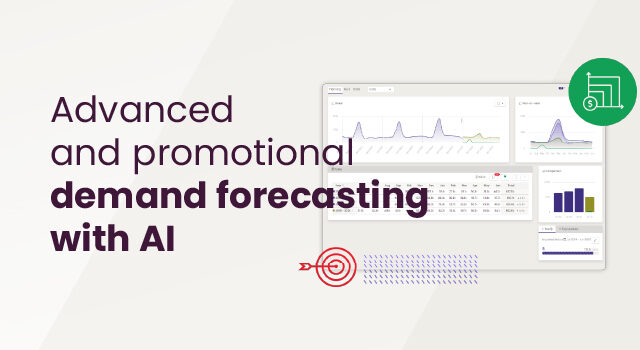
When a product with baseline sales of 1,000 units per month experiences a promotional surge to 1,800 units, traditional forecasting models immediately break down.
Determining whether that 80% volume spike represents a structural shift or a localized anomaly poses a significant challenge. Planners must project the impact of recurring promotional campaigns in subsequent cycles, balancing the need for sufficient safety stock to capture the full uplift against the risk of surplus inventory once demand normalizes.
Standard historical trend extrapolation lacks the analytical capability to navigate these complexities effectively.
AI-powered demand forecasting goes beyond simple historical averages by accounting for baseline seasonality, promotional spikes, and dynamic customer-level variations to generate highly accurate forward-looking projections.
This approach gives planners overseeing broader portfolios actionable intelligence. Rather than merely publishing static numbers, it flags real-time forecast risks to protect stock availability and minimize potential lost sales.
Key takeaways
- Separate promotional spikes from baseline demand. Distinguish temporary sales surges from lasting demand trends to avoid excess inventory or missed sales.
- Account for trends, seasonality and changing demand. AI-powered forecasting analyzes SKU-level patterns and adapts projections as new information becomes available.
- Forecast at a granular level. Understand demand variations across customers, locations and sales channels to position inventory where it is needed.
- Turn forecasts into action. Netstock AI Opportunities highlights potential stock-outs, surplus inventory and working capital risks so planners can prioritize replenishment decisions.
What is advanced demand forecasting?
Advanced demand forecasting uses AI and machine learning to analyze historical demand alongside patterns and events that can influence future sales.
Instead of relying on a single historical trend, an advanced forecasting engine can consider:
- Trend: Is demand growing, declining, or stable?
- Seasonality: Does demand consistently rise or fall at particular times of year?
- Demand variability: How predictable is the SKU?
- Outliers: Was an unusual sales spike a genuine change or a one-off event?
- Promotions and events: Is an upcoming campaign likely to change normal buying behavior?
- Customer and channel behavior: Does demand differ across customers, locations, or sales channels?
Netstock’s AI selects forecasting models based on the demand behavior of individual SKUs and continuously updates forecasts as new information becomes available.
That matters because a promotional spike is not the same thing as an underlying demand trend.
Why historical trend forecasting isn’t enough for promotions
While baseline sales history establishes a foundational trajectory, relying solely on historical averages fails to capture the full operational picture.
Take an item maintaining a consistent baseline velocity of roughly 1,000 monthly units.
When a Black Friday campaign pushes total volume to 1,800 units, standard trend models struggle to interpret the shift. A basic trend extrapolation evaluates the 1,800-unit figure in isolation.
However, inventory planners must evaluate a far more critical strategic question:
Does an 80% volume surge reflect an enduring market growth trend, or merely a localized buying anomaly?
Mistaking a temporary promotional uplift for a structural shift artificially inflates subsequent projections, leaving operations burdened with excess stock once purchasing normalizes.
Conversely, discounting the surge entirely creates severe stock availability risks and lost sales during subsequent promotional cycles.
Modern forecasting systems must accurately isolate the baseline demand trajectory from short-term demand drivers.
Netstock’s AI systematically accounts for promotional campaigns and dynamic events, filtering out non-recurring outliers to ensure baseline projections remain precise.
How Netstock’s AI handles trends and seasonality
Netstock’s core AI algorithms evaluate item-level demand patterns to automatically apply the optimal forecasting model for each unique velocity profile.
Trend
Trend tracking isolates whether underlying product volume is steadily expanding, contracting, or holding flat.
When an item demonstrates sustained upward momentum across consecutive cycles, the system projects this structural trajectory forward rather than defaulting to static historical averages.
Seasonality
Seasonal variations operate independently from baseline growth trajectories.
Certain SKUs see predictable demand changes throughout the year, from December sales peaks to January slowdowns and summer demand spikes.
Advanced demand forecasting systems automatically detect these cyclical rhythms, seamlessly integrating them into forward-looking inventory projections.
Differentiating these cycles becomes critical when a scheduled marketing campaign overlaps with a seasonal peak.
Demand planners must distinguish between two distinct operational drivers:
Standard seasonal spikes combined with promotional volume uplift
versus:
An enduring shift in baseline customer demand.
Netstock isolates seasonal fluctuations and recurring cycles throughout the automated forecasting workflow.
Worked example: What happens when a promotion creates a demand spike?
Consider a representative operational scenario.
A distributor manages a core SKU with a baseline velocity of roughly 1,000 units per month.
Historical purchasing data reveal predictable volume surges in November and December, driven by seasonal purchasing cycles.
To capture additional market share, the business executed a major promotional campaign in November.
Step 1: Establish the normal demand pattern
The analytical engine systematically evaluates the SKU’s historical consumption behavior.
It isolates underlying structural momentum and recurring seasonal fluctuations rather than analyzing monthly figures as isolated data points.
This process establishes a precise baseline projection of expected run rates under standard market conditions.
Step 2: Recognize the promotional event
The November initiative generates an extraordinary surge in volume.
Rather than misinterpreting this localized surge as a permanent structural shift in baseline velocity, the AI model explicitly accommodates the campaign as a discrete external demand driver.
Differentiating these variables is critical for stock stability.
The system must accurately project:
“What incremental uplift will the active promotional campaign generate?”
without incorrectly concluding:
“Will future baseline run-rates sustain this inflated peak indefinitely?”
Netstock’s AI demand forecasting engine isolates genuine structural shifts from temporary promotional spikes, protecting the underlying baseline trajectory from distortion.
Step 3: Translate the forecast into an inventory decision
Forward-looking projections deliver strategic value when integrated directly into purchasing workflows.
Inventory planners can evaluate current stock availability against projected campaign demand by synthesizing key operational inputs:
- On-hand stock levels
- In-bound purchase orders
- Supplier lead-time variance
- Dynamic safety stock requirements
- Scheduled stock receipts
- Target service level thresholds
Consequently, planners move beyond reviewing static sales projections.
They actively monitor the downstream working capital impact of the forecast.
Step 4: Watch for forecast risk
This integration highlights the strategic advantage of Netstock’s AI Opportunities capability.
When real-time consumption deviates from baseline expectations, operations teams require immediate visibility into potential stock-out or surplus risks.
AI Opportunities continuously evaluates inventory health, surfacing prioritized alerts to mitigate forecast risk before it impacts fulfillment or generates working capital drag.
This creates a seamless operational feedback loop:
Project demand → flag forecast risk → prioritize critical SKUs → execute corrective replenishment.
What about customer- and channel-level demand?
Promotions rarely impact every segment of an organization uniformly.
A digital marketing initiative might drive significant online volume while physical storefronts remain unaffected.
Similarly, a key account may submit a large seasonal order while standard purchasing velocity across other accounts remains flat.
A localized campaign might trigger a sudden surge in demand in one region while adjacent territories experience no change.
Under these conditions, relying on a single aggregated forecast obscures critical operational details.
Forecasting demand where it actually happens
Netstock enables multi-level forecasting across SKUs, accounts, territories, stocking locations, and distribution channels. This gives planners visibility into granular purchasing behavior rather than masking shifts inside high-level summaries.
Consider a product generating a baseline velocity of 10,000 monthly units:
- 4,000 units via retail locations
- 3,000 units via e-commerce storefronts
- 3,000 units via wholesale distributors
An online-exclusive promotion should not trigger proportional forecast increases across retail and wholesale streams.
Isolating localized demand signals allows operations teams to position stock precisely where consumption occurs.
Why forecast accuracy matters beyond the forecast itself
Generating accurate projections is not merely an academic exercise.
Underestimating consumption leads to stockouts, unfulfilled demand, expedited freight expenses, and diminished customer trust. Overestimating velocity creates bloated inventory, tied-up working capital, elevated holding costs, and eventual margin erosion from clearance markdowns.
Effective AI platforms must bridge the gap between forward-looking demand signals and active replenishment decisions.
Netstock’s engine surfaces consumption shifts to sharpen forecast precision, directly aligning demand insights with purchasing and supply chain execution.
From forecasting to action with Netstock AI Opportunities
Static projections outline expected market trajectory. However, supply chain leaders must address the practical execution:
What corrective operational steps should planners prioritize today?
Netstock’s AI Opportunities identifies stock risks and working capital inefficiencies across all inventory.
Instead of requiring planners to inspect thousands of SKUs manually, automated intelligence surfaces prioritized interventions to maximize capital efficiency.
Flagging risk before it becomes lost sales
Revisiting the promotional scenario illustrates this capability.
The updated model indicates an imminent surge in purchasing volume. Existing warehouse inventory appears adequate under standard conditions.
However, synthesizing campaign demand, current stock, open purchase orders, and vendor lead times reveals a high probability of premature stockouts.
This proactive insight transforms raw projections into actionable inventory strategies.
Planners can review automated recommendations, evaluate supplier constraints, and execute timely replenishment before service levels deteriorate.
AI Opportunities surfaces these critical exposure points, eliminating manual oversight and safeguarding order fulfillment.
What can better forecasting mean for lost sales?
The operational ROI of advanced forecasting depends on converting forward-looking visibility into effective inventory management.
For instance, Furnmart leverages AI-driven demand planning to oversee extensive portfolios spanning three countries and 170 retail locations. Netstock empowers their central planning team to establish accurate consolidated projections before seamlessly disaggregating replenishment down to store level.
This highlights a core principle for complex supply chain environments:
Forecast precision delivers maximum value when translated into targeted purchasing actions at the location level.
During promotional campaigns, this ensures adequate stock positioning within active fulfillment channels.
For seasonal cycles, it allows operations to scale inventory ahead of peak demand without accumulating post-holiday surplus.
When account behavior shifts, planners can adjust safety stock thresholds before macro averages obscure the underlying signal.
What makes Netstock’s approach different from basic trend forecasting?
Conventional trend extrapolation relies on a single backward-looking question:
“Assuming historical sales continue, what is the baseline projection?”
Advanced AI-driven planning evaluates a far more comprehensive set of operational variables:
- “Which structural patterns define this velocity profile?”
- “What portion of volume reflects predictable seasonality?”
- “Which historical demand spikes represent non-recurring anomalies?”
- “Does an unusual sales surge signal market growth or a localized promotion?”
- “How does demand behavior vary across customer tiers or distribution channels?”
- “Which forecast adjustments threaten service levels or working capital?”
Netstock’s AI systematically evaluates item-level consumption, filters outliers, isolates seasonal rhythms, and adjusts projections as market conditions evolve. AI Opportunities then guides planners directly to critical stock risks requiring immediate intervention.
This defines the evolution from passive historical extrapolation to active, AI-assisted inventory management.
Advanced demand forecasting gives planners more than a number
Promotional campaigns, seasonal cycles, channel shifts, and account variations cause future purchasing patterns to diverge sharply from historical averages.
Demand planners require flexible analytical engines capable of modeling complex operational drivers.
Netstock applies AI to analyze item-level demand behavior, filter promotional noise, accommodate cyclical variations, and adjust forecasts dynamically. Integrated AI Opportunities enhance this workflow by surfacing actionable stock alerts to protect fulfillment.
Ultimately, this delivers a strategic, decision-oriented planning framework:
Moving beyond “What is the forecast?” to “Where are consumption signals shifting, how do they impact working capital, and which purchase orders require execution?”