

▸ Table of contents:
0%
Inventory teams are surrounded by data – sales history, ERP records, supplier lead times, and seasonal trends that go back years. Yet, turning all this information into a reliable forecast remains a real challenge. Even with all this data at their fingertips, it’s rarely obvious what to order, when to reorder, or how much inventory to carry.
That’s where AI comes in. Instead of relying on one-size-fits-all formulas, AI-powered forecasting acts like a smart assistant that learns from every new piece of information. It spots patterns and signals that even the most experienced planner might miss, quickly turning your mountain of data into clear, timely answers.
In this guide, we’ll break down the basics of AI inventory forecasting, its benefits, and how to choose the right solution for your business.
Key takeaways
- AI inventory forecasting software is changing the way businesses do demand planning and manage supply chains by improving forecast accuracy and reducing stock-outs and excess inventory.
- AI inventory forecasting improves demand planning accuracy by analyzing a broader, more complex set of variables than traditional methods can handle.
- These tools enable faster decision-making, improve cross-team alignment, reduce carrying costs, and detect demand shifts before they become inventory problems.
- AI inventory forecasting methods work continuously, not on a fixed planning cycle.
- Modern AI inventory management software integrates directly with ERP systems, converting raw transactional data into actionable forecasting and replenishment recommendations.
What is AI inventory forecasting?
AI inventory forecasting uses artificial intelligence, particularly machine learning algorithms, to predict future product demand more accurately than traditional methods. It does this by analyzing a broader and more complex set of variables, including:
- Historical sales data
- Seasonality and promotions
- Economic indicators
- Weather patterns
- Supplier lead times and variability
- Demand outliers and anomalies
Unlike spreadsheet models or rules-based systems, AI can continuously learn and adapt, improving its predictions over time as new data arrives.
Why AI inventory forecasting matters to your business
AI inventory forecasting is an important tool because it continuously analyzes data. Then, it delivers timely recommendations that align with ever-shifting market conditions. Thanks to comprehensive, multi-channel data that backs up every decision, the risk of forecasting errors is reduced.
With supply chain disruptions, rising tariffs, inflation, and increased competition, the cost of forecasting errors can be astronomical.
Stock-outs lead to lost sales and frustrated customers.
Excess inventory ties up working capital and drives up carrying costs.
Manual processes, even carefully managed, can’t keep pace with the volume and speed of data that modern supply chains generate.
AI inventory forecasting addresses this directly. Simply put, machine learning algorithms can sift through your data faster and more accurately, finding opportunities and spotting potential problems with a single click. It’s the kind of software that helps you make smarter decisions quickly, keeping your business on track and ready for whatever comes next.
AI isn’t just about automation or chatbots. It’s about getting the right inventory answers, right when you need them.
How AI tools can transform your operations
- Adapt in real-time: AI inventory forecasting detects trends and helps respond to demand shifts without unnecessary costs.
- Make smarter inventory decisions: Reduce stock-outs and excess inventory with precise, data-driven recommendations rather than gut-feel adjustments.
- Improve forecast accuracy: AI inventory forecasting methods continuously refine predictions based on actual outcomes and planner insights. This means your forecasts improve over time, not just at the moment you measure your first post-implementation benchmarks.
- Stay ahead of disruptions: AI identifies supply and demand risks before they impact service levels.
- Save time and reduce costs: Routine forecasting across hundreds or thousands of SKUs happens automatically, freeing planners to focus on strategic decisions that drive business growth.
- Enhance team alignment: When everyone works from the same AI-driven forecast, sales, procurement, and finance can plan from a shared, trusted view of demand.
- Seize opportunities early: AI uncovers risks and opportunities early, so you can act fast.
The opportunity
In just one year, AI adoption more than doubled among SMBs – rising from 23% in 2024 to 48% in 2025. Plans for future investment nearly doubled as well, with 49% of SMBs expecting to invest in AI in 2026.
Those who have already invested in AI forecasting are seeing the return first-hand:
- 80% have seen at least one opportunity worth at least $40,000.
- 75% have seen opportunities valued at $50,000 or more.
- 50% have seen opportunities worth more than $160,000.
The gap between early adopters and everyone else is both competitive and financial.
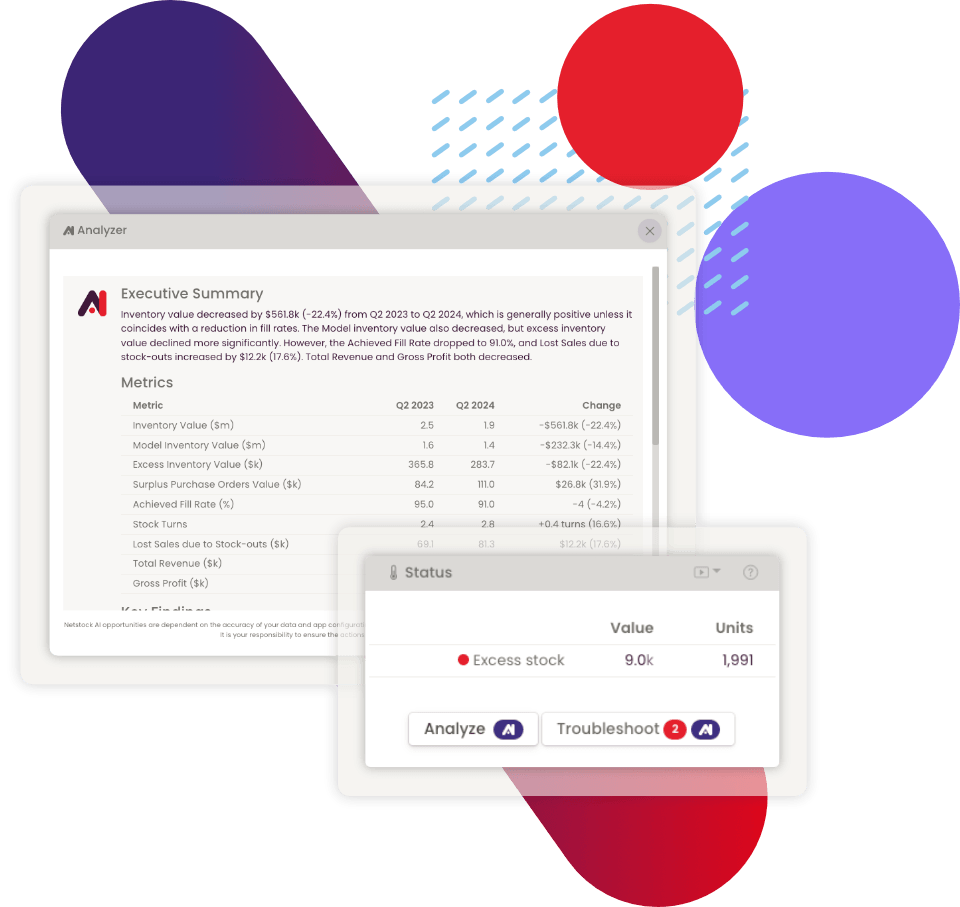
Netstock’s AI Opportunities™ analyzes inventory data across all locations to anticipate potential issues and deliver real-time recommendations. You can stay ahead of challenges and take action before they impact your business.
“The granularity of the AI Opportunities allows us to take targeted actions and develop tailored strategies for each store, taking into account the varying demands and customer preferences across different locations.” Aline Najjar, Harvey Norman – Australia.
AI inventory forecasting methods: What’s working under the hood
Understanding what AI inventory forecasting methods actually do helps you evaluate whether a solution is genuinely intelligent or just applying a label to a traditional algorithm.
Effective AI in inventory forecasting typically incorporates several distinct methods, often applied in combination.
Machine learning models analyze large volumes of historical sales and operational data from ERPs and other systems to identify patterns that inform demand predictions. Unlike static statistical models, they update continuously as new data arrives.
Anomaly and outlier detection identifies data points that fall outside expected ranges. No matter what the anomaly looks like (a one-time spike from a clearance event, a data entry error, or an unusual sales pattern), AI prevents it from distorting the underlying forecast baseline.
Seasonality and trend decomposition separates recurring patterns (a product that always peaks in Q4) from broader trends (a category growing 8% year over year). This way, both recurring patterns and long-term trends can be modeled and applied correctly.
Zero-demand and intermittent-demand handling addresses a common failure mode in traditional forecasting: SKUs that sell rarely or sporadically are often misforecast by models built for high-volume, stable items. AI methods designed for intermittent demand handle these SKUs correctly.
Real-time data integration feeds live sales, inventory, and order data from ERP and POS systems directly into the forecasting engine, so forecasts reflect what’s happening today.
Together, these methods produce a forecast that is more accurate across a wider range of SKU types, with less manual intervention required to maintain it.
How to choose the right AI inventory forecasting software
AI-powered inventory forecasting software can transform your supply chain operations, but not all AI solutions deliver on that promise equally. Choosing the right AI solution goes beyond ticking boxes; it’s about understanding your business’s current position and what it needs as it grows.
First, get honest about where your business is in its journey.
Think of your business’s journey like a road trip. Whether you’re just starting with inventory management or leading the market, knowing where you stand today is key to choosing the right software. The stage your business is at will determine how you can leverage AI.
For early-stage business:
Build a reliable data foundation first. Clean, consistent ERP data is what AI forecasting learns from. The better your inputs, the more accurate and useful the outputs. Once your data infrastructure is solid, AI becomes a genuine accelerant.
For mature business:
AI for inventory management can drive continuous improvement and unlock optimization opportunities for efficiency and innovation at scale. Align your software choice with your business’s maturity to ensure smooth integration and maximum ROI.
How to evaluate AI inventory forecasting solutions
Once you’ve defined what your business stands to gain from AI adoption, you’re ready to compare solutions.
With so many AI-powered inventory tools out there, how do you know which solution is right for your business? Following these steps can help you find the best tool for you:
- Know what your business really needs
Start with your specific pain points. Is the primary problem forecasting accuracy? Excess inventory? Stock-outs? Supplier lead-time variability? The answer shapes which capabilities matter most and must be non-negotiable for the solution you choose.
- Confirm the AI is real
Not every solution that uses the word “AI” delivers genuine machine learning-driven forecasting. Look for evidence of how the system handles different demand types, how it updates as new data comes in, and how it explains its recommendations. Ask vendors questions about how the functionality works behind the scenes to give you smarter forecasts, better insights, and time-saving automation.
- Think about cost and future growth
It’s not just about today’s costs – think long-term. Consider the total cost of ownership and return over time. A solution that fits today’s needs but can’t scale with your SKU count or location footprint will create problems later.
- Ensure seamless ERP integration
AI inventory forecasting is only as good as the data feeding it. Look for solutions purpose-built to integrate with your ERP, automatically converting raw transactional data into forecasting inputs without manual exports or data prep. Netstock connects with all leading ERP systems for exactly this reason.
Before implementation, spend time mapping what data lives where in your current systems. You’ll want to get a solid grasp of where data lives in your ERP system. For example, consider these questions:
- Does receiving customer orders allocate or reserve stock for the order?
- What is the cost price (latest or average)?
- How are lead times set: at the supplier level or product-location level?
- Is a Bill of Materials (BOM) in use?
- Are there open purchase orders the system needs to account for?
- Prioritize actionable insights, not just numbers
The output of AI inventory forecasting should be decisions, not just data. Look for a system that translates forecasts directly into replenishment recommendations, safety stock adjustments, and exception alerts.
- Evaluate the supporting feature set
The forecasting engine is the core, but the surrounding capabilities matter too: executive dashboards, supplier performance monitoring, excess redistribution, S&OP support, and reporting tools all influence how effectively a planning team can act on what the AI surfaces.
- Prioritize customer onboarding, support, and training
Even the best software only delivers value when the team using it is confident and capable. Look for vendors with a structured implementation process, documented best practices, and accessible ongoing support.
- Data Security and Certifications
Data security should be a top priority when selecting software. Netstock is ISO 27001-certified, ensuring your data is handled to the highest security and compliance standards. Rest easy knowing your business’s sensitive information is protected.
Choosing AI inventory forecasting software doesn’t have to be complicated. With these tips in mind, you’ll be better equipped to find a demand and supply planning solution that fits your business and helps you grow.
Planning for tomorrow with Netstock
Staying competitive means staying ahead of how planning itself has evolved. Businesses that build AI into their forecasting and inventory decisions are now creating an operational advantage that compounds over time.
As AI for inventory forecasting evolves, businesses that embrace innovation will thrive.
At Netstock, innovation is in our DNA. From day one, we’ve been dedicated to helping SMBs manage inventory smarter, compete on a larger scale, and adapt to change with ease. Our AI tools are the next step in this journey—bringing advanced technology that evolves with your business, delivering smarter insights, and keeping you one step ahead.
Why Netstock’s AI inventory management software?
- Not just any AI: Netstock AI is built on decades of inventory expertise. Our tools are purpose-built for supply chain planning, not general-purpose AI applied to an inventory problem.
- Data you can trust: Our responsible AI approach keeps your data secure within the Netstock ecosystem.
- Always evolving: We continuously innovate and improve our AI capabilities, so you’re always working with a system that reflects current best practices. Our ongoing innovations help you adapt to market changes and compete with enterprise-level businesses.
- Built for real results: Purpose-built, easy to use, and designed to deliver real, measurable improvements in service levels, inventory investment, and planning efficiency.
- Speed and agility: Netstock AI gives you the ability to respond to market changes faster than competitors still running on manual forecasting cycles.
Integrating artificial intelligence is a fundamental aspect of Netstock’s ongoing product roadmap. We aim to harness the value of AI and apply it responsibly to deliver meaningful supply and demand capabilities to our customers. Our mission remains committed to empowering our customers with the best-in-breed solutions so they can be market-ready, agile, and profitable – Barry Kukkuk, CTO and co-founder at Netstock.
Your competitors are investing in AI. Do you want to be left behind?
See what’s possible with advanced AI-powered inventory management and forecasting software today.
Get started with Netstock
Frequently asked questions about AI inventory forecasting
What’s the difference between AI inventory forecasting software and traditional inventory systems?
Traditional systems are reactive -they tell you what happened. AI inventory forecasting software is predictive – telling you what will happen and what to do about it. Traditional systems use basic reorder points and manual analysis, while AI continuously analyzes demand patterns in real-time, automatically adjusts forecasts, and provides actionable recommendations. Think of it as GPS with traffic updates versus a rearview mirror.
What AI inventory forecasting methods are most effective?
The most effective approaches combine multiple methods rather than relying on a single model. Machine learning models that adapt continuously, use anomaly and outlier detection, consider seasonality and trend decomposition, and leverage real-time ERP data integration all work together to produce forecasts that are accurate across a wide range of SKU types, including volatile, intermittent, and slow-moving items that traditional models struggle with.
Can AI inventory forecasting software integrate with my existing ERP system?
Yes, modern AI inventory forecasting and management software integrates seamlessly with existing ERP systems. Netstock connects with all leading ERPs, including SAP, Oracle, Microsoft Dynamics, NetSuite and Sage.
What size business benefits most from AI stock management tools?
AI inventory management delivers value across all business sizes. SMBs gain competitive advantages and typically see inventory reduction within a few months. Mid-market companies benefit from multi-location optimization and supply chain visibility. Enterprise businesses leverage AI for complex global operations. The key factors are inventory complexity, not just company size.
More guides
5 Steps to Managing Your Suppliers like a PRO!
Effective supplier management goes beyond transactions; it’s about collaboration and shared goals.
Download Now
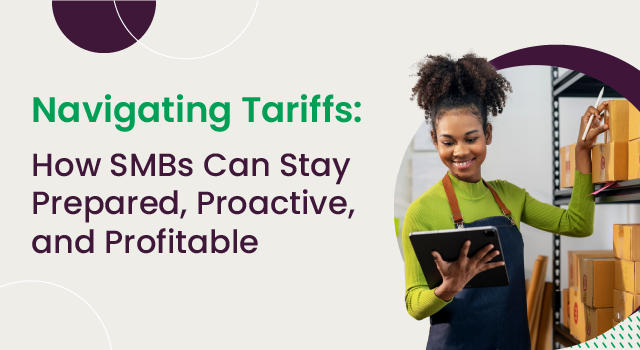
Navigating Tariffs: How SMBs Can Stay Prepared, Proactive, and Profitable
Struggling with rising tariffs and supply chain chaos? Discover how SMBs are tackling today’s biggest planning challenges.
Read More
From Chaos to Control: How Predictive Analytics Transforms Inventory Management
Imagine this: You’re a supply chain manager at a mid-sized retail company in December.
Read More
Make Smarter Inventory Decisions with Generative AI
Picture this: A boutique owner stares at her holiday inventory plan, remembering last year’s costly mistakes.
Read More
5 Step Inventory Planning Guide for Manufacturers
A practical approach for manufacturers to navigate supply chain disruptions by enhancing inventory visibility, improving
Download Now
Ready to explore Netstock’s AI Pack?
Fill in the form to connect with our team
Ready to start your inventory AI journey?
Discover more about Netstock’s demand and supply planning software
