

Automotive supply chain optimization:
▸ Table of contents:
0%
Tariff volatility, supplier disruptions, and unpredictable demand have reshaped how automotive manufacturers and parts suppliers manage their inventories. Each day, you’re managing the flow of hundreds of parts, balancing inventory levels to meet demand without tying up too much capital.
Whether it’s fulfilling a large order or handling a sudden rush for a specific part, predicting demand and optimizing your stock is crucial. With little room for error, staying competitive and profitable hinges on effective inventory management.
This guide breaks down the challenges automotive supply chain managers face today and offers strategies to address to help businesses build long-term resilience.
Quick insights
- Automotive supply chains face intensifying pressure from tariff volatility, supplier fragmentation, high SKU complexity, and parts obsolescence as vehicle models change faster than ever.
- Data-driven forecasting, optimized replenishment, and cross-team collaborative planning are essential. They’re the core strategies businesses can adopt to minimize waste and keep parts available when and where they’re needed.
- AI improves inventory and forecasting accuracy at the SKU level. It also flags supply risks before stock-outs occur, enabling scenario planning for disruptions such as tariff changes or supplier delays.
- ERPs may track inventory, but they don’t predict it. Choosing the right demand planning software means paying close attention to multi-location inventory, variable lead times, and high SKU counts. Feature lists alone won’t cut it.
- Long-term resilience comes from building planning discipline that absorbs disruption, not just trying to avoid it completely.
1. Key inventory challenges facing automotive supply chains
The spare parts industry doesn’t behave like most inventory categories. Vehicle production cycles, model changes, and warranty periods all shift demand for specific parts on a timeline that’s hard to predict from sales history alone. Add tariff-driven cost changes and stretched supplier networks, and inventory decisions carry more risk and less margin for error than they did a few years ago.
- Demand uncertainty: Predicting which parts will be needed and in what quantities is challenging due to a vehicle’s lifespan.
- Tariff volatility: Shifting trade policy changes landed costs and sourcing economics with little warning, forcing constant reassessment of supplier and inventory strategy, forcing constant reassessment of reorder points, safety stock, and which suppliers to lean on.
- High SKU complexity: Managing a vast inventory of different parts for multiple vehicle models can make demand forecasting and stock optimization difficult.
- Lead times & supplier reliability: Long lead times and unreliable suppliers can disrupt the supply chain, making it hard to maintain optimal stock levels.
- Obsolescence: Parts can become obsolete as vehicle models change, leading to excess inventory or stock-outs if demand shifts unexpectedly.
- Global supply chain disruptions: Relying on international suppliers means a single trade restriction or shipping delay can leave specific SKUs stranded, forcing a choice between air-frighting replacements or running lean on parts you can’t easily substitute.
- Cost management: Balancing inventory costs, including storage and capital tied up in stock, while ensuring parts availability, can be a significant stressor.
- AI adoption gaps: Many automotive supply chains still rely on manual forecasting and spreadsheets, leaving them slower to detect risk and adapt to disruption than competitors using predictive planning tools.
How can you tackle these challenges?
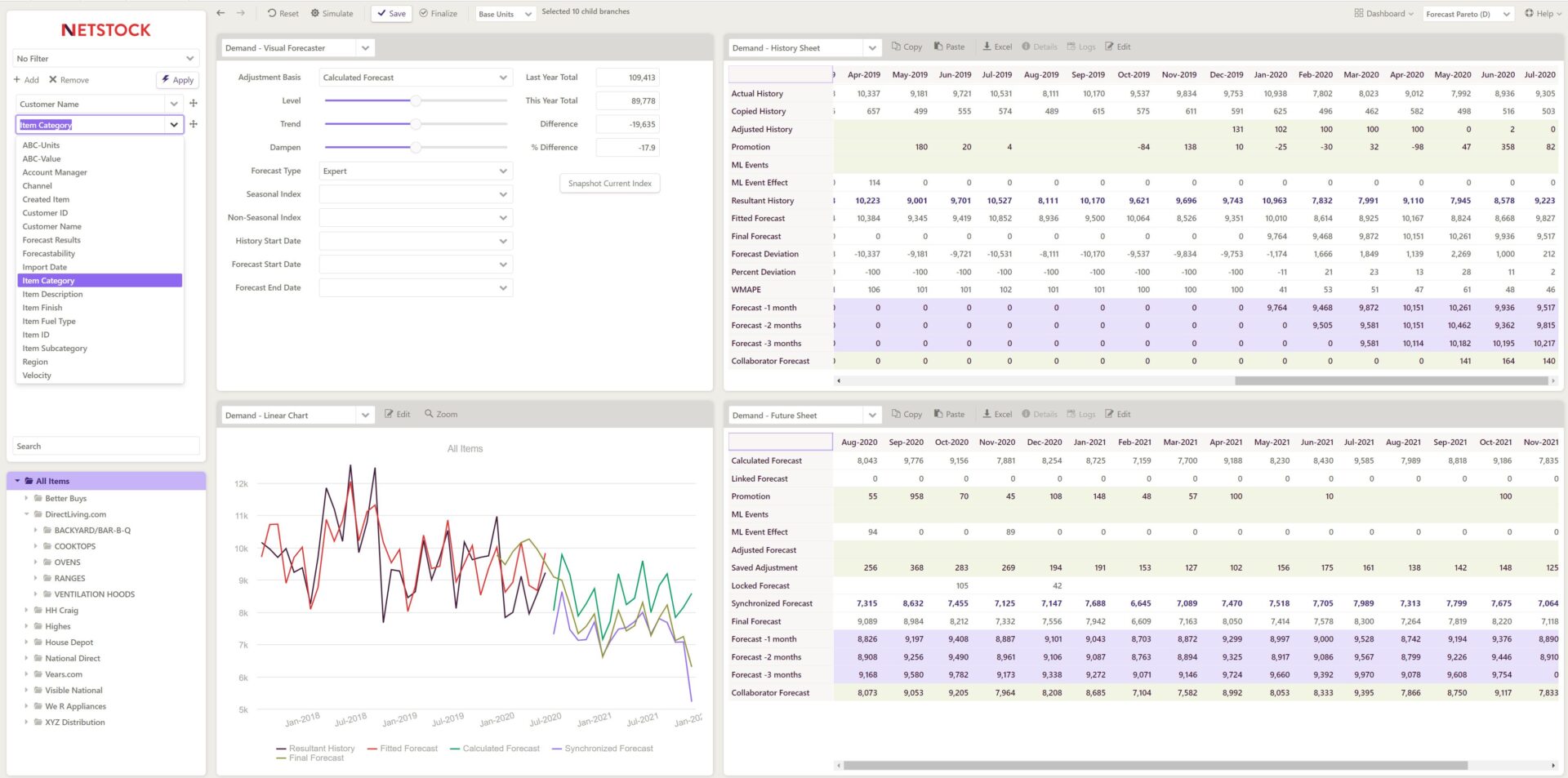
The right demand planning software turns these pressures into specific, manageable inventory decisions: How much safety stock to carry, when to reorder, and which parts are at risk before a stock-out happens.
Learn more about Netstock's supply chain planning suite
2. Inventory strategies that solve automotive’s biggest planning problems
The global supply chain is complex and delicate, so having the right processes in place is vital to keeping your business moving forward and profitable. As the saying goes, sticking with old ways will not lead to new results.
For automotive supply chains specifically, that means addressing the pain points that show up most often: thousands of SKUs across multiple vehicle models, parts that go obsolete the moment a model changes, and supplier networks fragmented across regions and tiers.
Here’s what to put in place, and the automotive-specific problem each one solves:
- Data-driven forecasting: Use historical data and predictive analytics to accurately forecast demand. For high-SKU automotive catalogs, this is what separates an accurate forecast from a guess across thousands of part numbers.
- Optimize replenishment: Optimize SKU levels and redistribute surplus stock to balance inventory. When a model is discontinued, redistributing surplus parts to areas where demand still exists prevents obsolescence write-offs that erode margins.
- Inventory optimization: Ensure visibility to avoid stock-outs and excess inventory, meeting demand on time. Item-level visibility matters most when SKU complexity is high; without it, slow movers and fast movers get managed the same way, which is rarely the right call for either.
- Collaborative planning: Align forecasts and plans across sales, marketing, production, and logistics teams. A model change or warranty campaign affects every one of these teams at once, so plans built in isolation tend to fall out of sync fast.
- Supplier management: Maintain strong relationships and monitor performance for timely deliveries and competitive pricing. With supplier networks this fragmented across regions and tiers, knowing which suppliers are reliable before a disruption hits is worth more than scrambling to find out after.
- Continuous improvement: Regularly review and enhance processes based on performance metrics and scenario planning. As tariff and trade policies shift, scenario planning lets you stress-test sourcing decisions before committing capital.
Put together, these processes minimize waste, keep parts consistently available, manage costs, and protect the competitive position that comes from delivering the right parts on time.
Here’s what that looks like for one automotive parts business that put it into practice.
We lacked the mathematical input to be able to make data-driven accurate forecasts so we would often end up in either a stockout or excess-stock situation. We needed to get the right parts in at the right time, and this is what drove us to look for an inventory optimization solution.
-LMC Truck
3. Where AI improves inventory forecasting and risk detection
Automotive supply chains generate large volumes of transaction data across SKUs, locations, and suppliers. It’s more than any planner can review manually. AI changes what’s possible with that data in three practical ways.
- Sharper demand forecasting: Instead of applying a single forecasting method across an entire catalog, multiple models can be considered to account for vehicle lifecycle stage, seasonality, and historical volatility at the SKU level.
- SKU-level risk flagging: Anomaly detection surfaces which parts are trending toward a stock-out or excess position before it happens, and pattern recognition can catch supplier lead time creep across historical orders, a signal that’s nearly impossible to spot by eye across a high-SKU catalog.
- Scenario planning for disruption: When a tariff shift or supplier delay hits, AI-powered planning tools let you model the impact across your network before committing to a sourcing or stocking decision.
4. Selecting demand planning software built for automotive inventory
While ERP software tracks inventory levels, locations, and movements, it doesn’t tell you how much inventory you should have – and it can’t flag a stock-out or excess position before it happens. That gap is what a dedicated demand planning solution is built to close.
How to evaluate your options
Choose software that fits your business’s unique needs and goals. That means a solution built to handle multi-location inventory, long and variable supplier lead times, and high SKU counts without breaking down at scale. Take the following steps:
- Define requirements: Pin down the specific gaps in demand forecasting, inventory optimization, and supply chain visibility you need to solve.
- Research solutions: Compare platforms built for the automotive spare parts industry, not generic inventory tools retrofitted to fit.
- Demo: Test usability and integration with your existing ERP before committing.
- Implementation and support: Confirm the provider offers hands-on onboarding and ongoing support, not just a license.
We’ve written a more in-depth article about selecting the right software solution in our blog.
Read the guide
5. Inventory planning features to look for
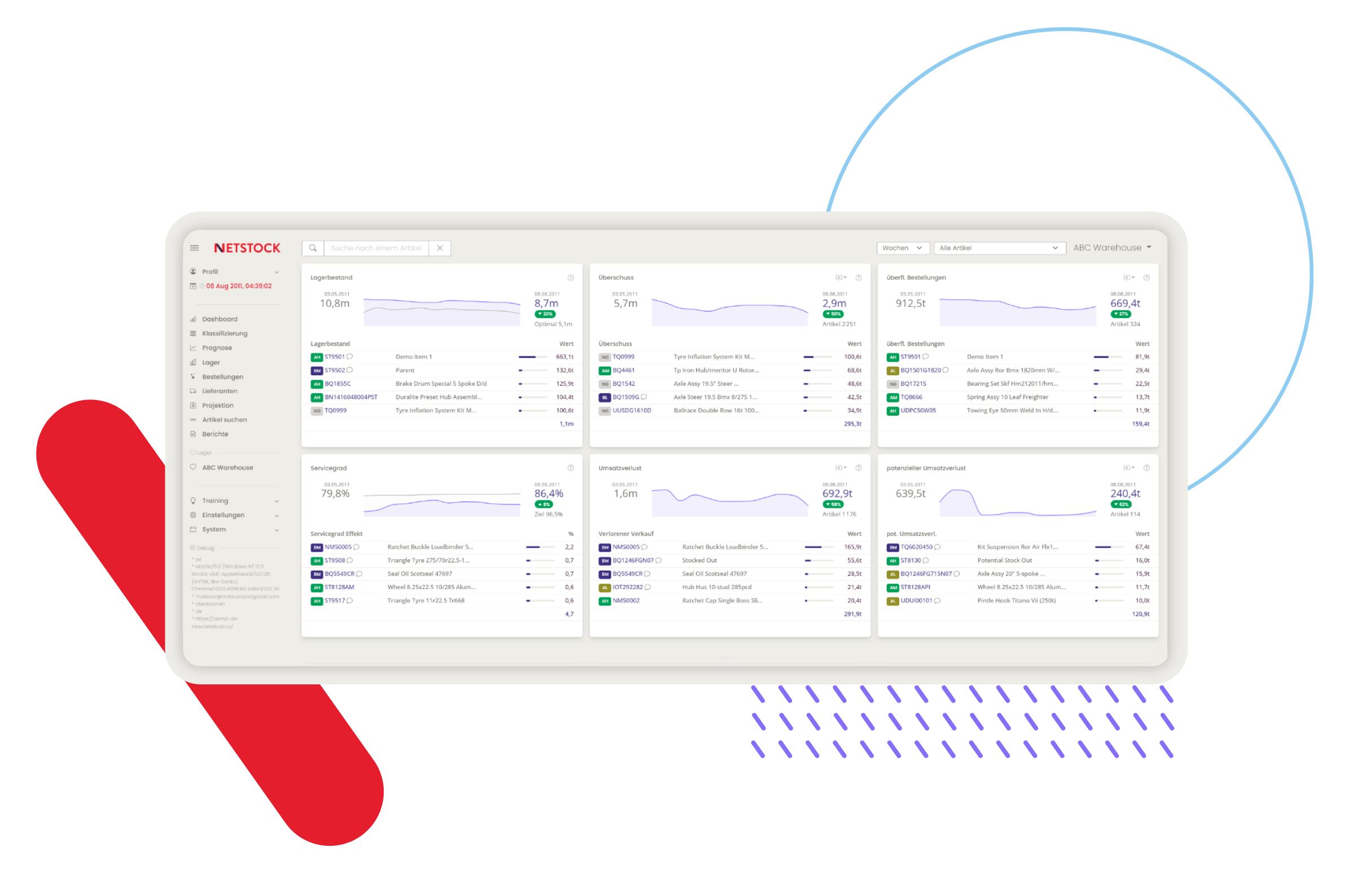
With the right supply and demand planning software, managing your inventory is like fine-tuning a well-oiled machine. You can quickly adjust inventory levels, instantly see the impact of new parts or promotions, and always be ready to adapt to unexpected changes in demand. For an automotive buyer managing high SKU counts across multiple locations, these features need to hold up at scale, not just work in a demo with a handful of parts.
Here are some features your supply planning software should offer:
- Single view dashboard: prioritized dashboards pre-configured to show the KPIs and metrics that matter most for your business and easily track performance.
- Redistribute excess: seamlessly identify and redistribute stock to where it’s needed most, whether it’s from one location to many or from many locations to one.
- Auto-generate orders: generate recommended purchase orders, work orders for production, and distribution plans to restock inventory across your network.
- Manage diverse product catalogs: using predictive analytics to optimize inventory and capacity planning.
- Assign the best demand forecasting models: forecast by each item, customer, region, unit, price, cost, or margin.
- Automatically classify spare parts: reduce obsolescence and free up resources and time to focus on the right parts to meet demand.
- Measure supplier performance: identify and work with reliable suppliers, increase collaboration, improve lead times, and automatically adjust safety stock levels.
Did you know…
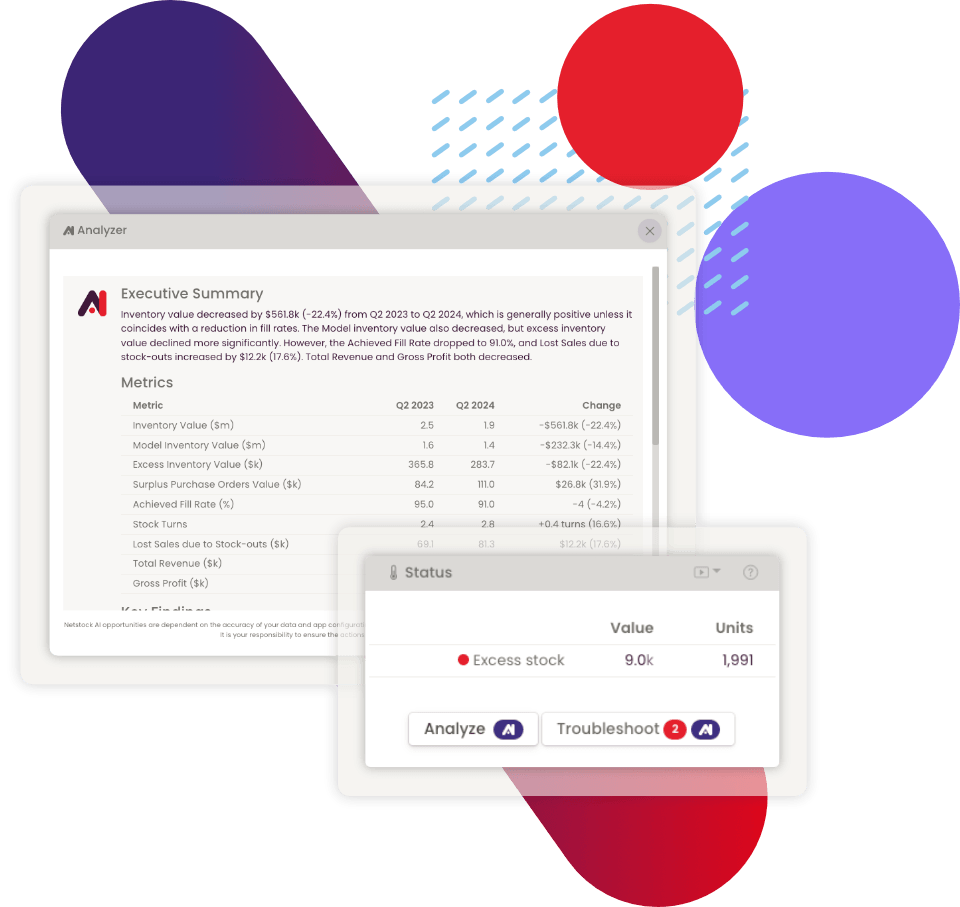
With Netstock’s AI Opportunities™, you can prevent issues before they occur by analyzing inventory data across all locations. This AI functionality suggests realtime actions to optimize stock levels, predict stock-outs, and reduce excess inventory.
See AI Opportunities in action

6. Building inventory resilience for the long-term
Optimizing demand and supply planning puts you in the driver’s seat – it’s crucial for staying competitive and satisfying customers. Tariff shifts, supplier disruptions, and demand swings aren’t going away. The businesses that come out ahead won’t be the ones that avoid every disruption. Instead, they’ll be the ones that built the visibility and planning discipline to adapt to it. That’s what resilience looks like in practice.
Your business can build this resilience, too. Here’s how:
- Evaluate your current processes: Examine your operations closely to identify areas where better planning could make a big difference, from forecast accuracy on high-SKU parts to how exposed you are to a single supplier or region.
- Find the right solution: Look for automotive supply chain planning software with flexible forecasting and inventory optimization built for automotive’s high SKU counts, multi-location complexity, and variable lead times.
- Plan your implementation: Map out how you’ll introduce these tools, including training and support, to ensure a smooth transition across every location and team that touches inventory.
- Keep improving: Continuously monitor your performance and use insights to fine-tune your strategies for even better results, especially as tariffs, supplier conditions, and vehicle models continue to change.
Ready to build that resilience into your supply chain?
Contact Netstock and find out how our solutions can help optimize your demand and supply planning.
Get Started
More guides

5 Steps to Managing Your Suppliers like a PRO!
Effective supplier management goes beyond transactions; it’s about collaboration and shared goals.
Read More

Navigating Tariffs: How SMBs Can Stay Prepared, Proactive, and Profitable
Struggling with rising tariffs and supply chain chaos? Discover how SMBs are tackling today’s biggest planning challenges.
Read More
From Chaos to Control: How Predictive Analytics Transforms Inventory Management
Imagine this: You’re a supply chain manager at a mid-sized retail company in December.
Read More

Make Smarter Inventory Decisions with Generative AI
Picture this: A boutique owner stares at her holiday inventory plan, remembering last year’s costly mistakes.
Read More
5 Hidden Causes of Excess Inventory
Learn the key steps to reduce excess inventory and enable smarter inventory decisions for your business.
Read More
AI+Inventory. Built for your business.
Accelerate supply chain planning for building supplies with predictive forecasting software.
Request a demo and see Netstock in action.
Ready to start your inventory AI journey?
Discover more about Netstock’s demand and supply planning software
