Your supply chain is only as strong as its weakest link, yet your business depends heavily on its performance. Just one unreliable supplier can take your supply chain from high-performing to sub-optimal. That’s not a position any business wants to be in.
Conducting a thorough performance analysis and completing regular supplier risk assessments is the key to maintaining service levels and a frictionless supply chain. Having a clear picture of where supplier challenges lie can help reduce performance problems, identify areas for improvement, and build strong relationships. An effective supply chain leads to improved business efficiency, customer service, sales, and profits.
On top of the business benefits that come from improved visibility, completing these activities is essential in the context of today’s global supply chains. According to the Netstock Supply Chain Benchmark Report, supplier reliability is a major concern for SMBs. Many businesses struggle with supplier costs, long lead times, supplier minimum order quantity (MOQ), and partial deliveries.
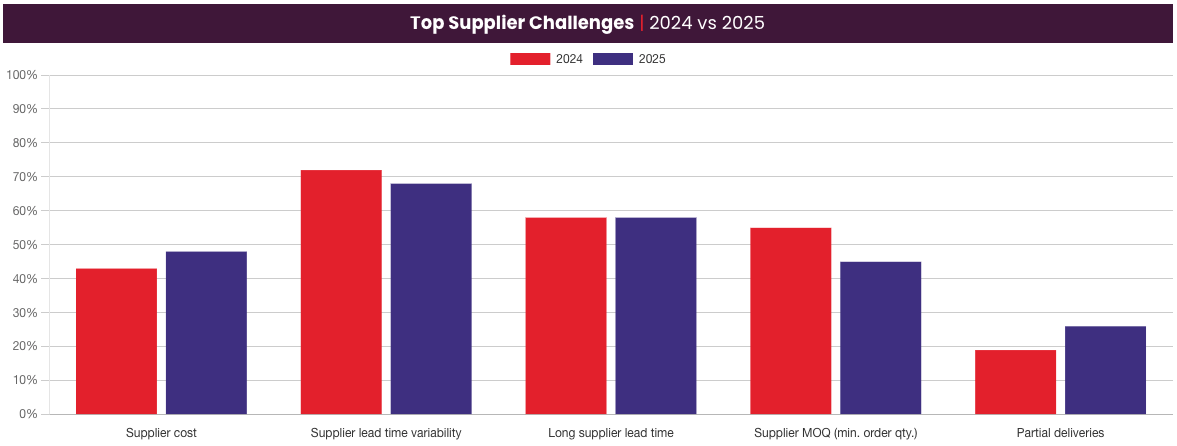
These challenges highlight that a “good” supplier is not just one that delivers on time, but one that excels in a range of areas. Alongside that, a supplier can introduce risk into your supply chain in more than one way. That’s why it is important to evaluate supplier performance and do a comprehensive risk assessment so you know where your vulnerabilities are and when it might be time to find a new vendor.
Key takeaways
- Start by reviewing delivery reliability. Track On-time delivery (OTD) and lead time variability to minimize safety stock costs.
- Quality is paramount when it comes to both performance (past) and risk (future). Evaluate defect rates, return rates, and compliance with specifications to protect brand reputation.
- When evaluating a supplier, you must understand the total cost of ownership (TCO) of the relationship. Look beyond the unit price to include shipping, storage, and quality control costs.
- Having a clear picture of the supplier’s operations, performance, and how these elements impact your business helps with future risk mitigation. Many SMBs use dual sourcing and contingency planning to protect against supply chain disruptions.
- Effective communication is at the core of both a supplier performance review and a risk assessment. Build trust through transparency and collaborative tools to resolve issues quickly.
What is a supplier risk assessment?
A supplier risk assessment is a structured evaluation of the risks a vendor could introduce into your supply chain. These risks range from quality and delivery failures to financial instability and compliance gaps. A supplier risk assessment combines historical performance data with forward-looking risk factors to score suppliers, so you know which relationships need closer monitoring or a backup plan.
Supplier risk assessment criteria |
|
|---|---|
| Criterion (risk type) | What it evaluates |
| Performance risk | On-time delivery, order accuracy, and quality defect rates |
| Financial risk | The supplier’s financial stability, including credit history, cash flow, and pricing volatility |
| Operational risk | Production capacity, geographic concentration, and business continuity planning |
| Compliance risk | Adherence to industry certifications, regulatory requirements, and contractual obligations |
Why is a supplier risk assessment important?
Conducting a supplier risk assessment helps identify possible future risks and supply chain disruptions. The risk could come from anywhere; external issues like natural disasters, political risks such as international trade policies, and internal variables like labor unrest and equipment failure are supply chain risk factors that could cause supply interruptions.
If you can see and understand the risks, you have the opportunity to take steps to reduce their likelihood and impact. After all, you can’t avoid or plan for these things if you don’t see them coming.
On top of that, you have the volatility of modern supply chains to consider. While much of it, including the impact of tariffs on SMBs, is outside of your control, what you do have power over is your ability to build and maintain a network of trusted suppliers.
What is the difference between a supplier risk assessment and a supplier performance analysis?
A supplier performance analysis looks backward. It measures how a vendor has previously performed in terms of things like delivery and quality. A supplier risk assessment, on the other hand, looks forward. These two activities are connected because a risk assessment uses the performance data as a foundation. A risk assessment adds external factors (e.g., financial health, geopolitical exposure, single-source dependency, etc.) to the equation to estimate the likelihood of future disruption.
5 Key factors to consider when evaluating supplier performance
As supplier performance data is the foundation of a comprehensive risk assessment, it’s important to make sure that your appraisal covers five key areas.
Some businesses add other criteria to the list when reviewing performance. No matter what elements are part of your process in addition to these five, keep in mind that your supplier performance criteria must support your business goals.
1. Quality of products or services
Product or service quality refers to the extent to which the product or service conforms with the set standards and specifications. Quality is more than the product’s physical attributes. It also applies to the reliability, consistency, and fitness for use. A good supplier will deliver a product that meets the buyer’s specifications and expectations.
The supplier’s ability to deliver quality products can significantly impact profitability. Poor quality can lead to delays and increased inspection and rework costs. Subpar quality will also upset customers. Returns will increase, potentially causing stock-outs, and the brand reputation could suffer. Over time, customers may defect to your competition.
2. Delivery performance
Smooth operations and the fulfillment of customer expectations depend on the smooth delivery of products. Delays are costly, especially in businesses that depend on Just-in-Time (JIT) delivery systems. With such systems, any delay will stop production, and sales will suffer.
| Metric | Importance |
| On-Time Delivery (OTD) | Measures the percentage of orders delivered by the promised date. |
| Lead Time Consistency | Reduces the need for high safety stock and lowers holding costs. |
| Supplier Flexibility | Ability to adapt to changes in specifications or sudden demand shifts. |
Lead time, the time between order placement and delivery, is another vital supply aspect. Short, predictable lead times make it easier to plan production and inventory.
3. Cost competitiveness
The lowest price is very often not the best buy. When assessing cost-effectiveness, buyers must evaluate cost vs. value. Value includes product quality, reliability, customer service, and flexibility.
Businesses must consider the Total Cost of Ownership (TCO) when evaluating cost. This method accounts for all direct and indirect costs of buying from a supplier. Costs include shipping, handling, storage, and quality control. Use the TCO to avoid hidden costs and evaluate the true cost of buying a product.
4. Supplier reliability
Your company’s ability to meet operational goals and customer requirements depends on how reliable suppliers are. If you know when a supplier is set to deliver and how frequently they stay within the predetermined window, you can then make downstream production and sales decisions. Additionally, industry certifications, like ISO 27001 certified, show a commitment to maintaining high standards.
5. Communication and responsiveness
Strong supplier relationships start with effective communication. Your suppliers must understand your requirements and report problems promptly so you can act quickly. Transparency ensures no misunderstandings, supports mutual goals, and encourages collaboration. Open communication promotes problem-solving and builds trust between partners.
Collaborative tools can boost communication by promoting real-time communication. Platforms that provide shared dashboards and analytics promote collaboration. Shared forecasts, performance metrics, real-time inventory data, and supply chain visibility ensure that everyone stays informed.
How to conduct a supplier risk assessment
Once you have a full picture of current and past performance, you can begin the supplier risk assessment process. This process evaluates the following types of risk: Performance, financial, operational, and compliance.
- The first step in managing supplier risk is scoring each current supplier against these categories using a consistent scale.
- Weight the scores based on how critical that supplier is to your operations. For example, a single-source vendor for a key component deserves closer scrutiny than a low-volume backup supplier.
- Set thresholds that trigger action. A supplier who dips below an on-time delivery benchmark, or whose financial risk score rises, should prompt a documented mitigation step such as a corrective action plan, a request for a contingency inventory buffer, or the start of a search for a backup vendor.
Because supplier conditions change, a one-time assessment during supplier onboarding isn’t enough. Build risk scoring into your regular supplier reviews. Use the metrics you’re already tracking, like OTD, lead time, and defect rates, to flag risk before it becomes a disruption. Modern demand and supply planning software can automate much of this scoring and alert you in real time.
Using technology to evaluate supplier risk and performance
Demand and supply planning software, like Netstock, streamlines the review and assessment process by tracking and analyzing supplier performance in real time.
- Track OTD, order accuracy, and lead time in real time.
- Identify performance trends and improvement areas.
- Identify risks with risk alerts and scenario planning.
- Use scenario planning to make contingency plans to quickly recover from supply interruptions.
- Reduce the risk impact with automated safety stock based on demand variability and supplier reliability.
- Improve forecast accuracy with advanced forecasting algorithms and adjust orders before disruptions happen.
With the intelligent layer Netstock provides, you can measure and review supplier performance and improve delivery with real-time insights and exception reporting. Predictive analytics also make it possible to take your performance analysis a step further, turning it into a true risk assessment. Purpose-built AI helps businesses identify weak spots and risks that could leave their supply chain vulnerable.
“We use the supplier performance functionality [in Netstock] to track our poor-performing suppliers so we can review and eliminate any extended lead times to avoid a build-up of backorders. We are also able to develop our supplier relationships and understand their frustrations so we can make necessary adjustments to our ordering frequency without presenting a risk to the business.” – Stonegate Tooling
Monitoring supplier performance drives continuous improvements.
Monitoring and measuring supplier performance is crucial for managing partnerships and driving improvements. Take it from Eastern Warehouse Distributors, a Netstock customer, that leverages the platform for supplier performance management.
“Netstock has provided us with increased visibility and flexibility in decision-making. Our relationships with suppliers have significantly improved with clearer anticipated orders. They appreciate the transparency and reliability in our projections, allowing them to plan their production more efficiently.” – Eastern Warehouse Distributors.
Supplier performance management solutions also provide early insights into supplier risks that could derail your supply chain if left unchecked. Using the right software will help build strong supplier relationships, minimize supply interruptions, and boost business efficiency.