Vendors showcase scenario planning in demos, analysts highlight it in reports, and leadership teams ask “what if” whenever supply chains stall, demand shifts, or costs rise.
Before adding scenario planning to your software requirements, apply what we call the decision test: Will it change a decision your business makes in the next planning cycle?
For some businesses, the answer is yes. A manufacturer committing to production months in advance, or a distributor evaluating alternative suppliers, may need to understand how several possible outcomes affect costs, inventory, and service levels.
For others, the immediate challenge might be inaccurate forecasts, excess inventory, or unreliable supplier lead times. Addressing those fundamentals could deliver greater value before investing in more advanced modeling.
The distinction matters for small and mid-sized businesses working with limited planning resources. Scenario planning requires reliable data, time to maintain assumptions, and people who can translate results into decisions.
This guide explains what scenario planning is, when it makes sense to invest in software with scenario planning, and how to determine which capabilities to include on your requirements list.
Key takeaways
- Most SMBs need scenario planning only when a high-impact decision depends on several uncertain variables and they have the data and people to act on the results.
- Scenario planning is valuable when complex supply chains, volatile demand, or major financial commitments make it difficult to rely on a single forecast.
- Many inventory challenges can be addressed first through better forecasting, safety stock, lead-time tracking, and exception management.
- Reliable data and a clear decision to support are essential before investing in advanced scenario modeling.
- The right planning software should help your team make better purchasing, inventory, and supplier decisions, whether or not full scenario modeling is required.
What is scenario planning, and what do buyers really mean by it?
Scenario planning models how different assumptions about supply, demand, costs, or other variables could affect business outcomes. Rather than relying on a single forecast, planners evaluate alternative possibilities and consider how different decisions might perform under each set of conditions.
In inventory planning, this can range from a simple sensitivity check to a detailed simulation of an interconnected supply chain.
Three types of scenario planning
1. Simple sensitivity checks
These examine the impact of changing a single assumption, such as increasing supplier lead times, reducing demand, or raising purchasing costs.
2. What-if adjustments
These allow planners to adjust a forecast, purchasing plan, or other assumption to understand the potential impact before committing to a decision.
3. Full scenario modeling
This evaluates several interacting variables across products, suppliers, locations, production capacity, or a broader supply chain network. It’s particularly useful when decisions have significant financial or operational consequences.
These capabilities serve different needs. A distributor investigating the impact of a two-week supplier delay may only need a straightforward sensitivity check. A manufacturer comparing alternative sourcing strategies across several production sites may require more sophisticated modeling.
Scenario planning vs. S&OP vs. demand planning
| Capability | What it does | Example question |
| Demand planning | Forecasts future demand using historical patterns and known business changes | How much are we likely to sell next quarter? |
| Scenario planning | Evaluates alternative assumptions and their potential consequences | What happens if demand rises while a supplier is delayed? |
| Sales and operations planning (S&OP) | Aligns demand, supply, capacity, and financial objectives | Can we meet our sales plan within our operational and financial constraints? |
| Safety stock planning | Calculates buffer inventory to protect against supply and demand uncertainty | How much additional inventory do we need to meet our service target? |
Scenario planning can support S&OP by helping teams compare alternatives before agreeing on a plan. Demand forecasts provide an important baseline, while safety stock policies help translate uncertainty in supply and demand into inventory requirements.
Understanding these distinctions helps you identify the capability your business actually needs.
The inventory problems that often trigger a scenario planning request
Before investing in scenario modeling, identify the problem that prompted the request. Many common inventory challenges have more direct solutions.
| The problem | What you might think you need | What to investigate first |
| Repeated stock-outs | Scenario modeling | Forecast accuracy, safety stock, and reorder points |
| Excess inventory | Inventory simulations | Excess identification, purchasing policies, and redistribution across locations |
| Supplier delays | Disruption modeling | Actual lead-time variability, supplier reliability, and performance |
| Tariff uncertainty | Multiple tariff scenarios | Sensitivity checks on costs, lead time,s and purchasing commitments |
| Inaccurate forecasts | More advanced modeling | Demand cleansing, event correction, seasonali,ty and lost-sales correction |
Consider stock-outs. If safety stock is too low because supplier lead times aren’t reflected accurately in the planning system, modeling hypothetical disruptions won’t necessarily resolve the underlying problem. Better lead-time data and replenishment settings may deliver a more immediate improvement.
Not every late supplier calls for disruption modeling either. When a supplier is consistently late, the delay is predictable, and the fix is a more accurate planning lead time. Netstock separates predictable delays from unreliable ones: offset tracks how far actual deliveries typically deviate from the planned lead time, while supply risk measures how erratic late or short deliveries are. Both feed directly into safety stock.
Similarly, if excess inventory is building up because forecasts consistently overestimate demand, the priority should be to improve those forecasts and identify slow-moving products. When excess sits in one location and shortages in another, redistributing existing stock can resolve both before you place a new supplier order.
Disruptions create a different data problem. When a temporary event distorts your history, Netstock’s Event Correction lets you replace disrupted sales months or exclude months of unreliable deliveries, so forecasts, lead times and safety stock aren’t skewed once conditions return to normal.
The 2026 Netstock Supply Chain Planning Benchmark Report highlights why these fundamentals matter:
- 74% of SMBs experience supplier lead-time variability.
- 24% of SMBs report that more than 10% of their inventory is dead stock, up from 12% in 2024.
- The typical business turns inventory four times a year, compared with seven times for top performers.
- Only 7% of SMBs meet all four key performance indicators in the report.
These findings highlight the challenge of balancing inventory efficiency, availability, and supplier reliability. Before adding more advanced modeling, businesses should understand whether their existing planning processes can reliably identify and address these issues.
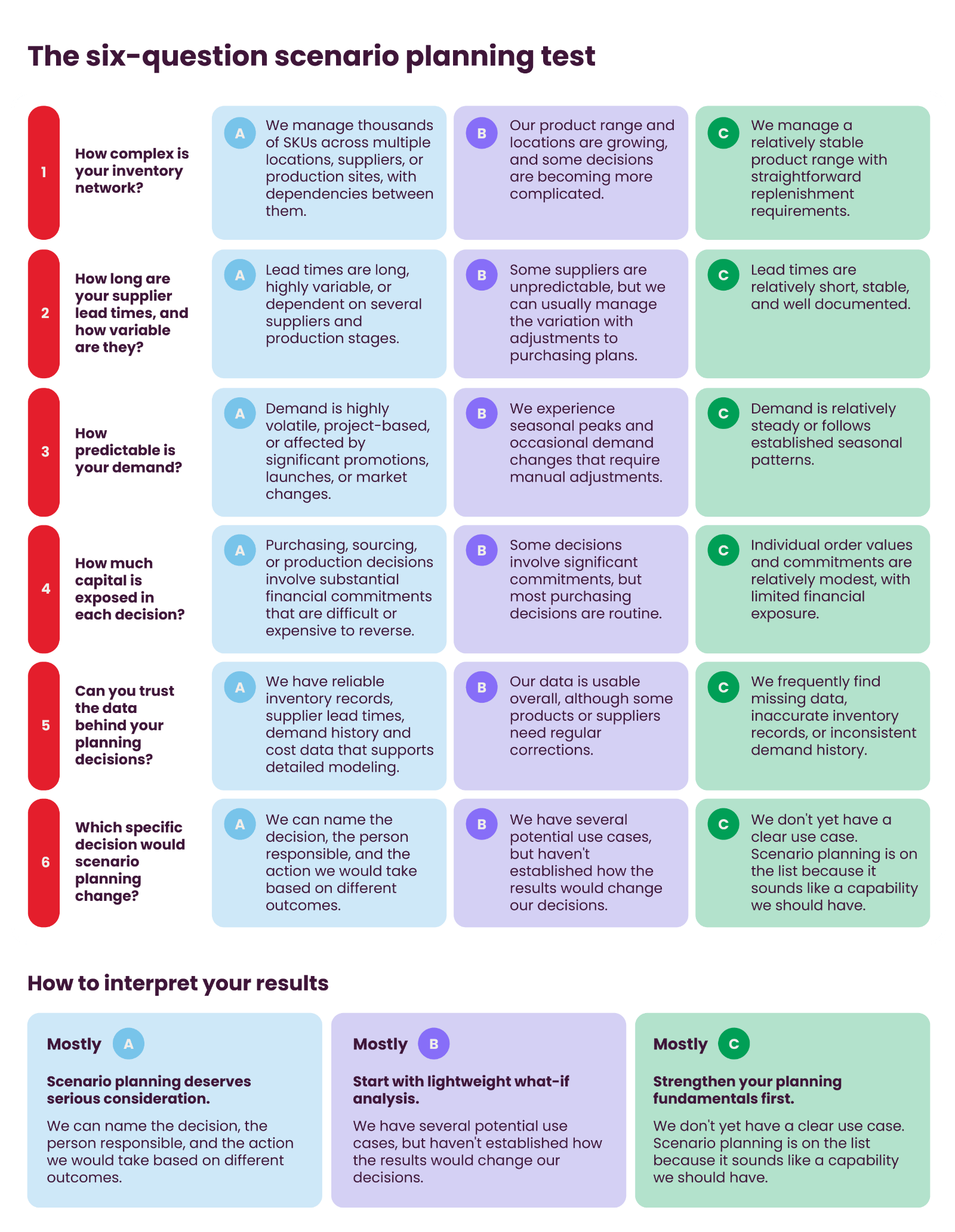
The six-question scenario planning test
These six questions expand the decision test into a fuller assessment of whether scenario planning belongs on your software requirements list. For each question, select the answer that best describes your business.
When do you genuinely need scenario planning?
Some businesses face decisions where evaluating several possible outcomes is essential.
Long, multi-tier supply chains
When a product depends on several suppliers, production stages, or distribution locations, one disruption can affect the wider network. Scenario modeling helps planners compare potential responses before committing resources.
Large, long-term purchasing commitments
Businesses buying seasonal inventory months in advance or committing substantial capital to production may need to understand how changes in demand, costs, or supplier availability could affect their financial exposure.
Highly volatile or project-based demand
Historical forecasts become less reliable when demand depends on major projects, one-off orders, product launches, or rapidly changing market conditions. Scenarios can help teams evaluate alternative demand assumptions before making purchasing or production commitments.
Sourcing, capacity and network decisions
Comparing alternative suppliers, production locations, capacity investments, or distribution strategies often requires evaluating several variables simultaneously. This is where more sophisticated modeling can be particularly valuable.
Businesses with the resources to use it
Scenario planning requires people who understand the business, maintain assumptions, and translate model outputs into decisions. The technology delivers value when it supports an established planning process.
Grundéns gives a real-life example. The apparel and fishing gear manufacturer grew from around 100–150 styles to more than 600, while managing production lead times of approximately 200 days with global vendors. With Netstock, the business improved forecasting and collaboration and incorporated scenario planning to evaluate potential tariff changes and their impact on costs and margins.
For a business facing similar long lead times and significant purchasing commitments, scenario planning can support decisions that would be difficult to reverse. The key is having a defined use case and reliable information to work with.
The real cost of scenario planning
Software licensing is only one part of the investment. Before committing to a planning solution, consider the work required to prepare data, configure models, establish assumption,s and maintain the process over time.
Data preparation is particularly important. Scenario results depend on the quality of inventory, demand, supplier, co,st and lead-time information. Missing or inaccurate inputs can make even sophisticated models misleading.
Then there’s the time required to build and run scenarios. Who will create them? How frequently will they be updated? Who will interpret the results and approve changes to purchasing, sourcing, or production plans?
Implementation and specialist support may also represent a significant commitment, depending on the complexity of the system and the business.
Finally, consider the opportunity cost. If planners spend hours developing scenarios but lack the capacity to act on the findings, the potential value remains unrealized.
Compare this with improvements that address immediate planning needs. Better replenishment recommendations, for example, can help planners identify what to order, when to order it, and which exceptions need attention.
Metalworks, a Canadian HVAC distributor managing more than 7,000 SKUs, illustrates the value of getting these fundamentals right. After implementing Netstock, the business reported 90% fewer stock-outs, 80% fewer potential stock-outs and three to four hours saved per day on planning. Its safety stock functionality also helps the team respond to sales spikes without constantly resetting parameters.
These results demonstrate the value of practical inventory planning. They shouldn’t be interpreted as a measured return from scenario modeling specifically.
Read the Metalworks case study.
Scenario planning answers an important question: What might happen if our assumptions change?
Operational inventory planning answers another: Given what we know today, what should we order, move, expedite or review?
Most businesses need to consider both. However, their relative importance depends on the decisions they make most frequently.
For an SMB managing a large product catalog, the immediate challenge may be identifying which items are at risk of stock-outs, where excess inventory is building up and which purchase orders need attention. That starts with knowing where the risk is. Netstock calculates risk for every SKU, at every location, every day, so planners don’t have to go looking for problems.
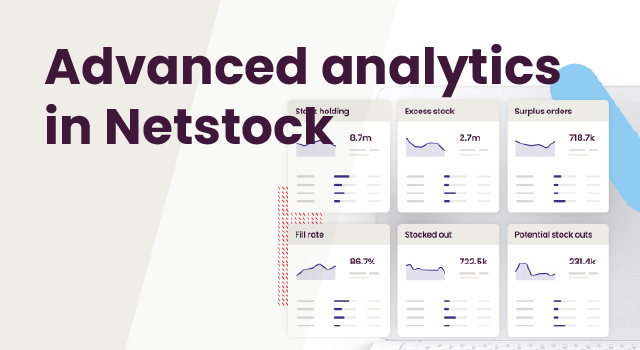
Netstock’s AI Opportunities then prioritizes what matters. It flags potential and actual stock-outs, surplus orders and excess stock, and recommends a specific action for each, such as expediting an order or moving stock between locations. Every recommendation is tied to a financial outcome, so planners can act on the issues with the biggest impact on service or working capital first.
Netstock has made more than 1.4 million AI recommendations, and over 75% of customers have unlocked $50,000 or more from AI opportunities.
Bargreen Ellingson, a foodservice and hospitality distributor operating 25 warehouses and working with more than 2,000 suppliers, provides a concrete example. Since implementing Netstock, the business has reduced excess inventory by more than $2 million, lowered stockholding from $17.8 million to $9.3 million, improved fill rates by 5% for high-turn items and reduced stock-outs to one-third of their previous level.
Its warehouse managers use Netstock’s AI Opportunities to identify and assess inventory actions, combining system recommendations with their knowledge of local demand and customer requirements.
Read the Bargreen Ellingson case study.
The broader lesson is that planning technology should support the decisions your team needs to make every day. For many SMBs, improving replenishment and acting on inventory exceptions is an important starting point, alongside any scenario planning required for more complex decisions.
A practical maturity path: build before you model
You don’t need to implement every planning capability at once. A staged approach allows each improvement to deliver value while preparing the business for more advanced analysis.
1. Establish reliable data and ERP integration
Ensure inventory records, demand history, supplier information and lead times are accurate and accessible.
2. Improve forecasting
Account for seasonality, trends, promotions and unusual demand events. Review forecast accuracy and correct for lost sales where possible.
3. Strengthen replenishment and exception management
Establish appropriate safety stock and reorder points, monitor supplier performance and prioritize items that need intervention.
4. Introduce simple what-if analysis
Test the impact of changes to demand, lead times or purchasing costs. Document the assumptions and decisions affected.
5. Implement full scenario modelingwhen the need is established
If decisions require multiple interacting variables, network-level analysis or long-term strategic evaluation, assess whether dedicated modeling can deliver a measurable benefit.
Each step can improve planning independently. You don’t have to wait until the final stage to see a return.
What should be on your inventory planning software requirements list?
For most SMBs, start with capabilities that support consistent day-to-day planning.
Must-have capabilities for most businesses:
- Reliable ERP integration and access to accurate planning data.
- Demand forecasting that accounts for relevant patterns and seasonal changes.
- Safety stock and replenishment planning.
- Exception management that directs planners towards priority items.
- Supplier lead-time tracking and visibility into supply risk.
- Clear, actionable recommendations that support purchasing and inventory decisions.
Useful depending on your requirements:
- What-if adjustments to demand and lead-time assumptions.
- Basic sensitivity checks for costs, supply changes and purchasing decisions.
- Collaborative planning processes that align supply, demand and finance.
Consider when your assessment justifies it:
- Full scenario modeling across multiple interacting variables.
- Network-wide supply chain simulations.
- Advanced analysis supporting sourcing, capacity, network design or major capital decisions.
Questions to ask any vendor showing you scenario planning
- Who will build, run and maintain the scenarios?
- How frequently will the scenarios be updated?
- Which specific business decision will each scenario change?
- What data and implementation effort are required to produce reliable results?
Ask for a demonstration using a real decision your business faces. The results should help you understand not only what could happen, but what the available choices mean for your business.
Buy for the decisions you need to make
Scenario planning can be extremely valuable. For businesses with complex networks, unpredictable demand or significant financial commitments, it provides a structured way to evaluate alternatives before taking action.
But the software feature should earn its place on your requirements list.
If your immediate challenges are inaccurate forecasts, unreliable lead times, excess inventory or recurring stock-outs, start by addressing those problems. If your business needs to compare complex, interconnected decisions, investigate scenario planning and ensure the necessary data, people and processes are in place.
Netstock supports inventory planning through forecasting, inventory optimization, ERP integration and AI-powered recommendations. Its scenario planning capabilities can also support businesses that need to evaluate potential changes to costs and margins, as demonstrated by Grundéns.
The right approach depends on your planning requirements, the complexity of your supply chain and the decisions you need to make.