AI is changing inventory planning, but its real value isn’t how impressive its answers sound. It’s whether AI helps businesses make better inventory planning decisions and act before problems affect customer service, cash flow and operations.
A large language module (LLM) with Excel can analyze data, build reports and answer questions. But there’s a big difference between generating useful insights and running an inventory planning process that turns those insights into action.
Purpose-built AI is artificial intelligence designed for a specific business function, using the data, business rules and workflows relevant to that function. Unlike a general-purpose LLM, it’s designed and tuned to recognize specific problems, provide relevant recommendations and support action within an established business process.
That’s where Netstock has an advantage. Its purpose-built AI works within an established planning solution that connects ERP data, forecasting, inventory optimization, replenishment and ordering. Rather than treating AI as a separate analytical tool, Netstock applies it directly to the decisions planners make every day. Inventory planning isn’t just about knowing what’s happening. It’s about doing something about it.
Key takeaways
- Execution delivers the results. A great forecast provides the signal, but the value only comes when the business acts on it in time.
- LLMs and Excel are valuable. They’re excellent for analysis, formulas, reports and learning, and they’re improving rapidly.
- The hard work is the process. Data integration, validation, exception management, security, testing and ERP execution still have to be built and maintained by someone.
- Compare total effort, not subscription cost. The real question is what it takes to run a reliable, repeatable planning process every day.
- AI should find the problems. Every day, Netstock’s AI Opportunities flags situations that need action, so planners don’t have to know every question to ask.
- Every flag comes with a fix. For potential stock-outs, it suggests expediting, an emergency order or a transfer. For surplus orders, it suggests reducing, delaying or canceling.
- Planners stay in control. Planners review, adjust and finalize every order before it’s transferred or exported to their ERP.
- Judge AI by outcomes. Look for fewer stock-outs, better availability, less cash tied up in excess, and fewer emergency orders.
Why isn’t a good forecast enough on its own?
A good forecast is essential. It provides the critical signal that drives inventory and replenishment decisions. But you don’t realize the value of a great forecast until you execute against it.
A great forecast won’t prevent a stock-out if nobody places the order in time or responds to a late delivery. It won’t reduce excess inventory if purchasing doesn’t respond to changing demand. And it won’t improve cash flow if the business can’t turn that forecast into better inventory decisions.
Forecast accuracy matters a lot, but accuracy alone doesn’t deliver the business outcome. Forecasting provides the signal but execution delivers the results.
This is especially important for small and midsize businesses (SMBs), where cash is limited, planning teams are small and mistakes can be costly to the business.
Execution needs to be:
- Prescriptive
- Complete
- Responsive
Planners need to know what action to take, when to take it, how much to order, change or move, and why. Identifying a potential stock-out isn’t enough if the planner must figure out the entire response.
That’s where AI should help. It shouldn’t create more analysis for someone to interpret. It should identify what matters and recommend practical actions.
Where does an LLM with Excel fall short in inventory planning?
LLMs have real value in a planning environment. They’re excellent tools for analyzing data, writing Excel formulas, creating spreadsheets, writing reports and learning, and they’re improving rapidly. Anything that helps a planner be more productive and produce better work is a good thing.
But creating a useful analysis with a prompt and a spreadsheet isn’t the same as having an inventory planning solution that operates consistently and reliably every day (and night) in a way you can track and explain.
A spreadsheet might correctly calculate a recommended order quantity. But is it using the latest inventory position? Does it account for outstanding orders, customer commitments, changing supplier lead times and inventory policies? Can the recommendation be carried through to execution? Who’s responsible for keeping everything working and up to date? And what if that person goes on vacation or leaves the company?
This isn’t a criticism of Excel. Excel performs well-defined calculations reliably when the data, formulas and assumptions are correct, and LLMs can do amazing things. The question is how much work it takes to build, maintain and support the complete process. Data integration, validation, exception management, security, testing and ERP execution don’t disappear because AI helped provide the answer.
There’s another important distinction.
An LLM may give a good answer to the question it receives. But what happens when nobody asks the right question? What about the stock-out nobody thought to investigate, or the surplus order that wasn’t included in the spreadsheet? Unless a business builds its own extensive automated monitoring and exception management process, those problems can go unnoticed.
This has been a recurring theme in recent discovery conversations with prospective Netstock customers. They describe relying on an LLM for planning but still spending large amounts of time on manual work:
- fixing imports and exports
- reconciling results
- transferring order recommendations into another system
- sometimes just trying to explain why the LLM did what it did
The goal should be less time maintaining the tools and more time making decisions. So the real comparison isn’t the cost of an AI subscription versus inventory planning software. It’s the total effort required to deliver and sustain a reliable, repeatable operating process.
How does an LLM with Excel compare with Netstock’s purpose-built AI?
| LLM with Excel | Netstock’s purpose-built AI | |
| Starting point | Your own data only, built from scratch | 15+ years and 42TB of SMB supply chain planning data |
| Best for | Analysis, formulas, spreadsheets, reports and learning | A daily, repeatable inventory planning process that ends in an order |
| Data | Whatever is in the spreadsheet; someone has to check it reflects the latest inventory, open orders and lead times | Works within a planning solution that connects ERP data, forecasting, optimization, replenishment and ordering |
| Finding problems | Answers the questions it’s asked | AI Opportunities flags potential stockouts and surplus orders every day, without being asked |
| Recommendations | An answer or calculation to interpret | A suggested action: expedite, place an emergency order, transfer, or reduce, delay or cancel an order |
| Explaining results | It can be hard to explain why the LLM did what it did | AI Pack tools explain item status, safety stock coverage and risk factors |
| Getting to an order | Recommendations are re-keyed into another system | Planners review, adjust and finalize orders for transfer or export to their ERP |
| Upkeep | Data integration, validation, exception management, security and testing are built and maintained in-house, often by one person | Part of an established planning solution |
Why not build your own AI planning process with an LLM?
Some businesses go further than ad hoc prompts. They connect an LLM to their ERP, write scripts and schedule reports. That can produce a solid view of historical performance. But to run inventory planning, a custom build has to do everything a planning solution does:
- check ERP data quality and correct sales history for stockouts
- calculate forecasts, safety stock and stocking policies for every item and location, the same way every day
- monitor for exceptions and prioritize the ones with the biggest financial impact
- get approved orders into the ERP
- stay secure, tested and documented as the ERP, the business and the LLM change
Each of these becomes your team’s job to build and keep running, and your risk if something breaks or the person who built it leaves the business.
Some things can’t be built at all. A custom setup only knows your own history. Netstock’s AI learns from 42TB of proprietary SMB inventory planning data built over more than 15 years, and from how planners at more than 2,500 customers adjust recommendations.
For a small range of items with steady demand, a well-maintained spreadsheet may be enough. Once a business is making hundreds or thousands of recurring inventory decisions, building and maintaining its own planning system becomes a second job.
How does purpose-built AI find problems before you ask?
One of the biggest advantages of purpose-built AI is that planners don’t have to know every question to ask.
Consider a business managing thousands of items across multiple locations, suppliers and lead times. Some items need immediate attention. Most don’t. The challenge isn’t simply analyzing the data. It’s knowing where to focus.
Every day, Netstock’s AI Opportunities analyzes inventory conditions across every item and location and identifies situations that may require action. It can flag potential stockouts and suggest expediting a purchase order, placing an emergency order or redistributing inventory. It can also highlight surplus orders that may need to be reduced, delayed or canceled.
Imagine one warehouse facing a stock-out while another has excess inventory. Rather than expecting a planner to discover both conditions, AI Opportunities identifies the situation and suggests a transfer. The planner still evaluates whether the recommendation is practical and makes financial sense, but the problem and a possible action have already been identified.
So far, Netstock’s AI has made more than 1.5 million recommendations, and over 75% of customers have unlocked $50,000 or more from AI Opportunities.
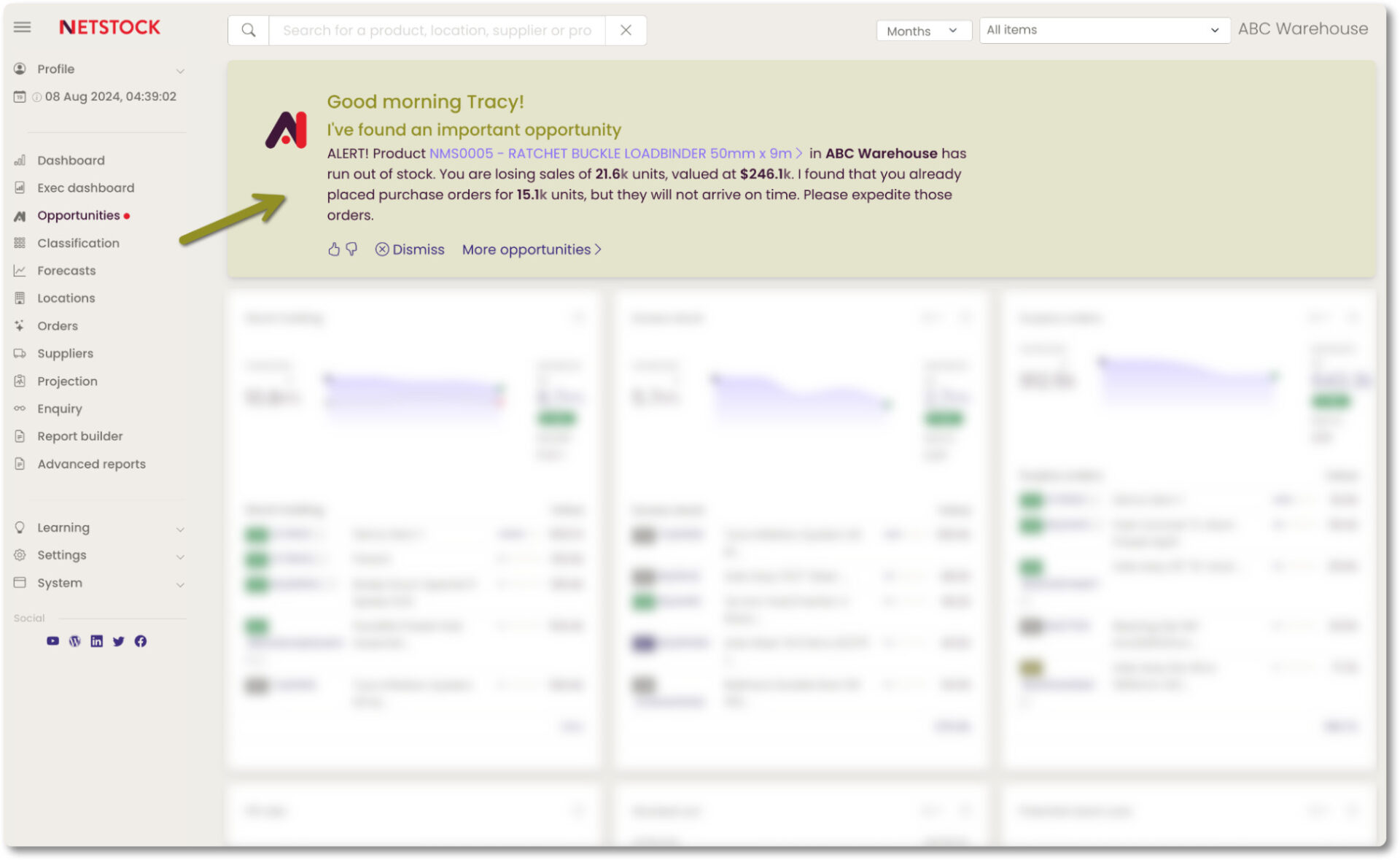
Netstock’s AI Opportunities shows you daily the top opportunities to action.
Which AI tools help planners understand and respond?
Netstock’s AI Pack builds on AI Opportunities with tools that help planners understand problems and act on them:
- Item Analyzer explains an item’s current status and what it means for the business, with immediate and longer-term ways to optimize its stock levels.
- Safety Stock Explainer breaks down an item’s current safety stock coverage and the risk factors behind it.
- Item Troubleshooter explains why an item issue matters and gives practical steps to resolve it.
- Inventory Email Agents draft supplier emails about surplus orders, late shipments or potential stockouts, and notify affected customers when issues arise.
Together, these tools help planners identify problems, understand their causes and decide what to do next. Planners don’t have to keep assembling data from spreadsheets and exports or work out the right prompt for an LLM.
How does Netstock turn recommendations into orders?
Identifying a problem is valuable, and understanding it is even better. But the benefit still depends on what happens next.
Netstock connects inventory planning to an established ordering process. Planners can review recommended quantities, investigate supporting information, make adjustments and finalize orders for transfer or export to their ERP.
The objective isn’t to remove people from every decision. It’s to give them dependable recommendations and let them focus their judgment where it adds value. AI should make planners more effective, not make the business more dependent on someone knowing the right question or prompt.
How should you judge AI in inventory planning?
AI shouldn’t be measured by how many features it offers or how convincingly it explains a problem. The questions that matter are practical:
- Are stock-outs declining?
- Is product availability improving?
- Is less cash tied up in excess inventory?
- Are emergency orders and expediting costs decreasing?
- Are planners spending less time gathering data and more time making decisions?
Better information and analysis are always good, but their greatest value comes when they’re connected to a responsive execution process. LLMs and Excel remain valuable tools for all kinds of work. They should complement a purpose-built planning solution rather than replace it.
For businesses making hundreds or thousands of recurring inventory decisions, Netstock provides an established planning foundation with AI designed to identify risks, explain problems, recommend responses and support execution. When you evaluate any solution, ask to see that complete process. Start with a real inventory problem, understand the AI’s recommendation and follow it through to ordering.
Knowing the plan isn’t enough
In inventory planning, it’s not enough to know what the plan is. You have to execute it.
Your planners already know your business. Netstock’s purpose-built AI makes sure they see what matters every day, know what to do about it, and act before small problems become costly ones.