Growing businesses know the feeling. Your ERP holds all the data you need, but extracting meaningful insights from it requires manual effort, fragmented reports, and educated guesswork. For companies using MYOB Acumatica, the system delivers strong foundational capabilities in finance, inventory, and operations management. Yet without the right connections, even the most robust ERP leaves teams reacting to inventory problems instead of preventing them.
Integration changes that dynamic entirely. When MYOB Acumatica connects with advanced inventory optimization solutions like Netstock, data transforms from a historical record into predictive intelligence. Leaders gain visibility into demand patterns, supplier performance, and inventory health without adding complexity or IT overhead. The result? Smarter decisions, lower operational friction, and a supply chain prepared for growth and resilience.
Key takeaways
- MYOB Acumatica provides a flexible ERP infrastructure. Integration with purpose-built solutions like Netstock unlocks predictive planning and proactive decision-making.
- Connected systems reduce manual data entry, forecasting errors, and reactive scrambling during disruptions.
- Netstock’s cloud-based connector continuously synchronizes with MYOB Acumatica, delivering real-time inventory optimization and demand forecasting.
- Integration supports scalability without enterprise-level IT resources or large-scale workflow disruptions.
Understanding MYOB Acumatica: The ERP built for connected operations
MYOB Acumatica stands out among cloud-based ERP systems for its modular design and open architecture. Built to unify finance, inventory management, procurement, and distribution, it provides small and mid-market businesses (SMBs) with enterprise-grade functionality without excessive complexity. Its cloud-first approach means teams can access critical data from anywhere, while its flexible API framework makes integration straightforward for businesses ready to extend capabilities beyond core ERP functions.
The platform handles essential operations effectively:
- Tracking inventory transactions
- Managing purchase orders
- Recording sales data
- Providing financial reporting
These functions create a reliable operational backbone. However, the difference between having data and leveraging data lies in how that information gets analyzed, interpreted, and acted upon. MYOB Acumatica establishes the foundation. Integration with specialized inventory optimization solutions lets businesses move beyond transaction-level tracking.
Why MYOB Acumatica integration matters
Supply chain leaders face mounting complexity. According to the 2025 Benchmark Report, 63% of SMBs experienced direct operational impacts from tariff changes, while 68% reported lead time variability as their top supplier challenge. Traditional methods of managing inventory through static rules and manual analysis cannot keep pace with this level of disruption.
MYOB Acumatica’s open API and cloud architecture make it well-suited for integration, yet many businesses have not fully leveraged this capability. Teams continue entering data manually across multiple systems, reconciling discrepancies between ERP records and planning spreadsheets, and making decisions based on outdated snapshots rather than live intelligence. Integration eliminates these friction points, allowing businesses to extract maximum value from their existing ERP investment while gaining the forecasting and optimization capabilities required to navigate volatility with confidence.
The integration opportunity: Turning ERP data into intelligence
Integrating inventory optimization software with MYOB Acumatica creates a continuous flow of actionable intelligence. Rather than exporting ERP data into spreadsheets for manual analysis, the integration allows Netstock to draw live information, including sales transactions, purchase orders, item masters, supplier lead times, and inventory positions across multiple locations, directly from the system.
This real-time synchronization enables inventory forecasting that considers seasonality, trends, and external variables. Replenishment planning becomes automated and optimized, balancing service level targets against working capital constraints. When supplier performance changes or demand patterns shift, the system immediately adapts its recommendations rather than waiting for the next planning cycle.
The technical flow works seamlessly: Netstock’s purpose-built connector communicates with MYOB Acumatica’s API to synchronize data at scheduled intervals or in real time, depending on business requirements. Item-level details, inventory movements, and financial data remain consistent across both platforms without manual intervention. This eliminates the data entry errors and version control issues that plague disconnected systems. Procurement teams see accurate calculations. Finance teams monitor working capital tied to inventory with precision. Operations teams adjust replenishment plans based on current conditions, rather than relying on a snapshot from the previous week.
The result is a unified view where ERP accuracy meets predictive intelligence, giving teams confidence that their decisions reflect both current reality and future demand.
MYOB Acumatica + Netstock: Side-by-side benefits
Understanding the practical difference between standalone ERP functionality and integrated optimization helps clarify where value emerges.
The table below contrasts typical capabilities before and after integration:
| Dimension | MYOB Acumatica (Standalone) | With Netstock Integration |
| Inventory visibility | Transactional, limited analytics | Predictive, real-time dashboards |
| Forecasting | Based on historical data | Demand-driven with machine learning |
| Replenishment | Manual, rules-based | Automated and optimized |
| Decision-making | Reactive | Proactive and data-informed |
| Scalability | ERP-centric | Supply chain ecosystem ready |
This distinction matters because businesses using MYOB Acumatica already have robust operational infrastructure. Integration builds on that foundation rather than replacing it. It extends capabilities in areas where ERP systems were never designed to specialize, including predictive analytics, scenario modeling, and continuous optimization.
Netstock’s recognition as the Most Innovative App of the Year by MYOB highlights the effective collaboration between the two platforms. The integration leverages MYOB Acumatica’s flexibility while delivering specialized inventory optimization that transforms how businesses plan, purchase, and manage stock.
Integration in action: From data sync to business insight
Deployment begins with connecting Netstock to MYOB Acumatica through the pre-built connector. Implementation typically requires minimal IT involvement. Netstock’s team handles configuration, data mapping, and validation to ensure accuracy from day one. Once connected, the system begins synchronizing data according to the business’s preferred schedule.
From there, the workflow becomes continuous. Sales transactions recorded in MYOB Acumatica flow into Netstock’s engine. Purchase orders generated by Netstock sync back to MYOB Acumatica for execution. Inventory levels update in real time across both systems. Procurement teams receive replenishment recommendations based on current stock positions, supplier lead times, and forecasted demand. Finance teams monitor working capital allocation with dashboards that reflect both operational and financial metrics.
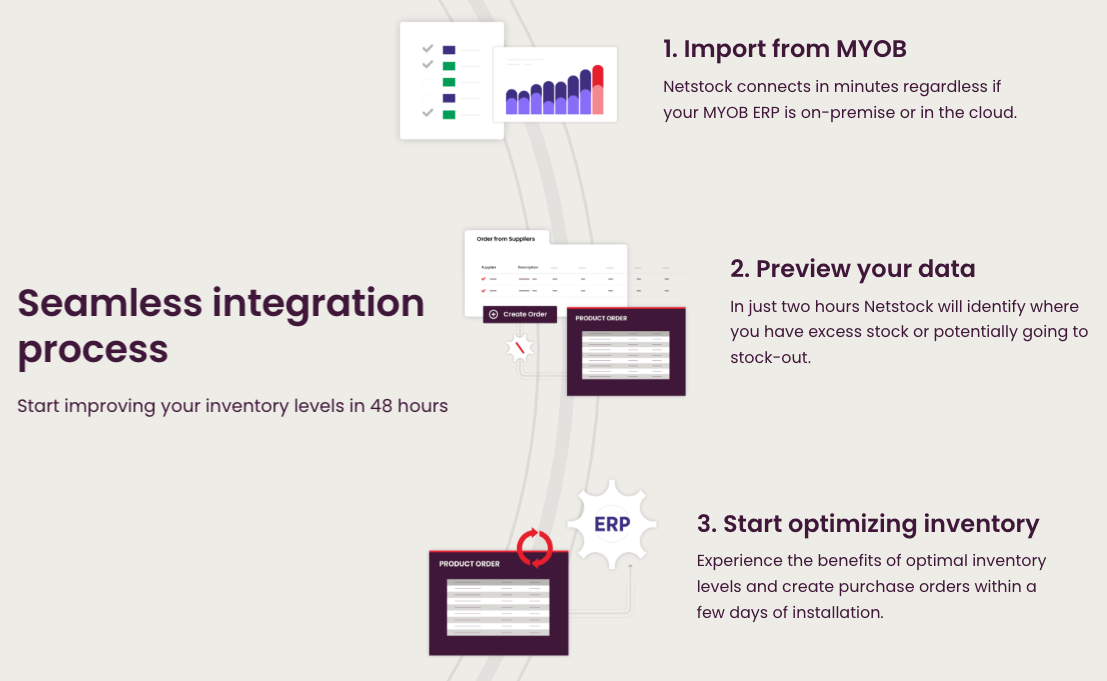
This seamless exchange enhances collaboration across departments. Sales teams gain visibility into inventory availability without pestering warehouse managers. Procurement teams prioritize orders based on forecast accuracy rather than gut instinct. Operations teams adjust plans proactively when supplier performance shifts. The integration creates a shared source of truth that aligns decision-making across the business, reducing the miscommunication and delays that often accompany fragmented systems.
Real-world impact: Helping SMBs scale with confidence
All Round Supplies, a business using MYOB Acumatica alongside Netstock, reported measurable improvements in inventory visibility and supplier performance through dashboards. Planners use time once reserved for manual spreadsheet management and calculations to focus on supplier performance management.
Hear more about their story and how Netstock has helped this team adapt to expanding stock profiles and changing markets.

ERP integration as a growth strategy, not an IT project
Many businesses view ERP integration as a technical initiative managed by IT departments. In practice, the most successful integrations are treated as strategic business investments. Connected systems provide the agility needed to respond quickly when market conditions shift, the transparency required to make confident capital allocation decisions, and the efficiency that allows lean teams to manage increasing complexity.
During periods of uncertainty, whether driven by tariffs, supplier disruptions, or demand volatility, businesses with integrated systems adapt faster. They model scenarios before committing resources, adjust replenishment plans based on real-time signals, and maintain service levels without tying up excess capital in safety stock. Competitors relying on manual processes and disconnected data sources spend critical time reconciling information and validating assumptions, often acting too late to prevent stock-outs or margin erosion.
Integration also supports long-term scalability. As businesses add product lines, enter new markets, or expand distribution networks, integrated systems scale alongside them. MYOB Acumatica provides the transactional backbone, while Netstock delivers the optimization intelligence needed to manage growing complexity without adding headcount or sacrificing accuracy.
Netstock + MYOB Acumatica: Built for simplicity and results
Netstock’s integration with MYOB Acumatica delivers several core advantages designed specifically for growing businesses:
- Rapid deployment: Purpose-built connectors reduce implementation time and eliminate custom coding requirements
- Real-time synchronization: Inventory, sales, and purchasing data remain consistent across both platforms without manual exports
- AI-powered forecasting: Machine learning algorithms analyze demand patterns and adjust predictions as conditions change
- Automated replenishment: System-generated purchase recommendations balance service levels, supplier lead times, and working capital constraints
- Scenario modeling: Test the financial impact of supply disruptions, demand shifts, or pricing changes before committing resources
- Unified dashboards: CFO-ready reporting consolidates operational and financial metrics in a single view
These capabilities work together to transform MYOB Acumatica from a transactional system into a strategic planning platform. Businesses gain enterprise-grade inventory intelligence without the complexity or cost typically associated with enterprise-level solutions.
Making integration your next competitive move
Supply chain resilience depends on the ability to see clearly, decide quickly, and act confidently. For businesses using MYOB Acumatica, integration with Netstock unlocks those capabilities by connecting operational data with predictive intelligence. The result is fewer surprises, stronger margins, and the agility to navigate disruption while maintaining customer satisfaction.
Businesses that integrate their ERP systems position themselves to grow sustainably, making informed decisions based on accurate forecasts rather than relying on reactive guesswork. Ready to discover how MYOB Acumatica integration can transform your inventory management and forecasting capabilities?
Learn More About MYOB Acumatica Integration