Cin7 Core delivers the cloud-native ERP foundation that omnichannel retailers need: unified order management, real-time channel integration, and comprehensive transaction tracking. But when it comes to forecasting demand spikes, optimizing stock levels across multiple locations, or anticipating seasonal shifts before they impact sales, many growing retailers discover they need more sophisticated inventory intelligence.
This is where integrating Netstock with Cin7 Core transforms good ERP functionality into exceptional omnichannel performance. Instead of reacting to stock-outs or sitting on excess inventory, retailers gain AI-driven forecasting that keeps the right products in the right places at the right time across every sales channel.
Key takeaways
- Cin7 Core integration with Netstock combines robust ERP functionality with advanced AI-driven inventory optimization that helps retailers avoid inventory issues before they arise..
- Omnichannel retailers gain predictive insights that balance stock across online, retail, and wholesale channels, so they can better serve customers across their network.
- AI-powered forecasting anticipates demand shifts, seasonal patterns, and channel-specific trends before they impact performance.
- Automated item classification and dynamic safety stock calculations eliminate manual planning inefficiencies, saving time and resources that can be reinvested back into the business.
- Seamless cloud integration enhances existing Cin7 workflows without disrupting daily operations.
Why Cin7 Core integration matters now
Retail complexity has exploded. What started as simple inventory management now involves coordinating stock across eCommerce platforms, physical stores, wholesale accounts, and third-party marketplaces. To make matters more complicated, each channel has different demand patterns, fulfillment requirements, and customer expectations, too!
Traditional approaches buckle under this complexity. Spreadsheet-based planning breaks down when managing thousands of SKUs across multiple channels. Basic ERP forecasting assumes predictable demand patterns, but modern retail faces constant volatility: flash sales, social media micro trends, supply chain disruptions, and shifting customer preferences.
Meanwhile, customer expectations continue rising. Shoppers expect products to be available when they want them, whether they’re browsing online at midnight or walking into a store on Saturday afternoon. Meeting these expectations while maintaining healthy margins requires inventory intelligence that goes beyond what standard ERP systems can provide.
What Cin7 Core delivers: And where retailers need more
Cin7 Core excels at what modern retailers need from their ERP foundation:
- Unified order processing across all channels
- Real-time inventory tracking
- Automated workflows
- Comprehensive reporting.
The platform handles complex scenarios like multi-location fulfillment, drop-shipping, and channel-specific pricing with the reliability that growing businesses need. Orders flow seamlessly between online stores and retail locations. Inventory movements are tracked in real-time. Financial reporting consolidates performance across all sales channels.
But even the most robust ERP system has limitations when it comes to predictive planning. Standard forecasting modules typically rely on historical sales averages. These work fine for stable demand but aren’t really meant for the volatility inherent in modern retail. Seasonal fluctuations, promotional impacts, and channel-specific trends require more sophisticated analysis than basic ERP forecasting can provide.
This gap becomes particularly challenging for growing retailers. As SKU counts expand and sales channels multiply, manual planning becomes impossible. Buyers spend more time reacting to stock-outs and excess inventory than strategically planning for growth. Without advanced forecasting capabilities, even efficient ERP systems can’t prevent the inventory imbalances that constrain cash flow and disappoint customers.
The breaking point: Where omnichannel inventory gets complicated
Most growing retailers hit the same wall: ERP efficiency can only take you so far when demand patterns become too complex for traditional forecasting methods.
Consider this scenario: An apparel retailer manages 12,000 SKUs across online stores, three physical locations, and wholesale accounts. Seasonal trends vary by region, online promotions affect in-store demand, and wholesale customers place large orders that can disrupt retail inventory levels. Basic forecasting might suggest reordering based on last month’s sales, but it can’t account for the interconnected demand patterns across channels.
The complexity compounds with growth. Adding new sales channels, expanding product lines, or opening additional locations multiplies the variables that affect inventory planning. SKU-level forecasting becomes increasingly time-consuming. Buyers struggle to balance competing priorities: maintaining service levels without tying up excessive capital in slow-moving inventory.
Common breaking points include:
- Channel conflicts: Online promotions creating unexpected demand at retail locations
- Location imbalances: Popular items are selling out in high-traffic stores while sitting in slower locations
- Seasonal miscalculations: Over-ordering trending items that quickly go out of style
- Working capital strain: Excess inventory in some SKUs, while others face chronic stockouts
These challenges aren’t failures of ERP systems, however. They’re simply the natural result of complexity that exceeds what traditional planning tools can handle effectively.
How Netstock supercharges Cin7 Core
Integrating Netstock with Cin7 Core transforms your ERP data into predictive intelligence that drives smarter inventory decisions across all channels.
The integration works by layering advanced forecasting algorithms on top of Cin7’s comprehensive transaction data. While Cin7 Core continues handling order processing, inventory tracking, and financial reporting, Netstock analyzes demand patterns, identifies trends, and generates optimized replenishment recommendations that account for channel-specific dynamics.
AI-driven forecasting without spreadsheets
Netstock’s predictive algorithms use your Cin7 Core data to forecast demand across products, locations, and seasons. Instead of relying on gut feel or spreadsheets, you get accurate, automated forecasts you can confidently implement. The system learns from actual sales performance to continuously improve accuracy across all your channels.
Automated, profit-driven item classification
Each SKU is automatically classified by sales value and velocity. High-impact items get priority attention, while lower-value and slower movers stop stealing your team’s focus. This automated classification ensures your buyers spend time on products that actually drive profit rather than getting bogged down in routine decisions about slow-moving inventory.
Dynamic safety stock calculations
Safety stock isn’t static in this integrated system. Netstock recalculates it daily, factoring in item classifications and supplier metrics. If a supplier’s lead times suddenly shift, Netstock automatically raises the buffer. This action protects you from stock-outs without unnecessarily bloating your warehouse with excess inventory.
Supplier performance intelligence
Leveraging your Cin7 Core transaction data, Netstock analyzes supplier behavior patterns to give you dependable lead time forecasting. The result? Reduced inventory disruptions, optimized stock thresholds, and strategic capital allocation that keeps service quality consistent across every sales channel.
Smart replenishment optimization
Netstock identifies the best productions to complete partially loaded shipments by analyzing your current stock levels. This ensures you’re shipping as efficiently as possible while preventing overstock situations that drain your cash flow unnecessarily.
Real-time visibility with trusted data
All your key stock metrics appear in one clean dashboard view: stock holding, surplus, fill rates, and service levels. Since Netstock integrates natively with your Cin7 Core system, you won’t spend time entering or checking data. Reliable insights are updated in real-time to help you make better inventory decisions faster.
Cin7 Core + Netstock: Side-by-side benefits
The difference becomes clear when you see the capabilities side by side. Here’s how the integration expands what your Cin7 Core system can accomplish:
| Function | Cin7 Core ERP | Cin7 + Netstock Integration |
| ERP Capabilities | Orders, channels, ERP | ERP + AI inventory planning |
| Inventory Management | Tracking & control | Optimization & forecasting |
| Omnichannel Visibility | Unified transactions | Predictive inventory insights |
| Scalability | Handles ERP needs | Supports rapid retail growth |
The integration preserves all existing Cin7 Core functionality while adding the predictive capabilities that growing omnichannel retailers need to maintain a competitive advantage.
Integration isn’t optional. It’s a competitive advantage.
Retailers using integrated ERP and inventory optimization consistently outperform competitors relying on ERP alone, and the performance gap widens as operational complexity increases.
The advantage shows up in measurable ways:
- Better service levels without higher inventory investment
- Faster response to demand changes
- More strategic use of working capital.
But the real competitive edge comes from operational resilience. When market conditions shift, integrated retailers adapt quickly while competitors struggle to respond.
This agility becomes particularly valuable during peak seasons or promotional periods. Retailers with predictive planning can anticipate demand surges and position inventory accordingly. Those relying on reactive planning often face a choice between stockouts that disappoint customers or excess inventory that strains cash flow.
The integration also enables more strategic growth decisions. Instead of wondering whether they can handle additional sales channels or product lines, retailers have data-driven confidence in their capacity to scale operations efficiently.
See how Pack Leader improved forecasting accuracy and reduced excess stock by integrating Netstock with Cin7.

Netstock + Cin7 Core: Seamless integration, stronger retail outcomes
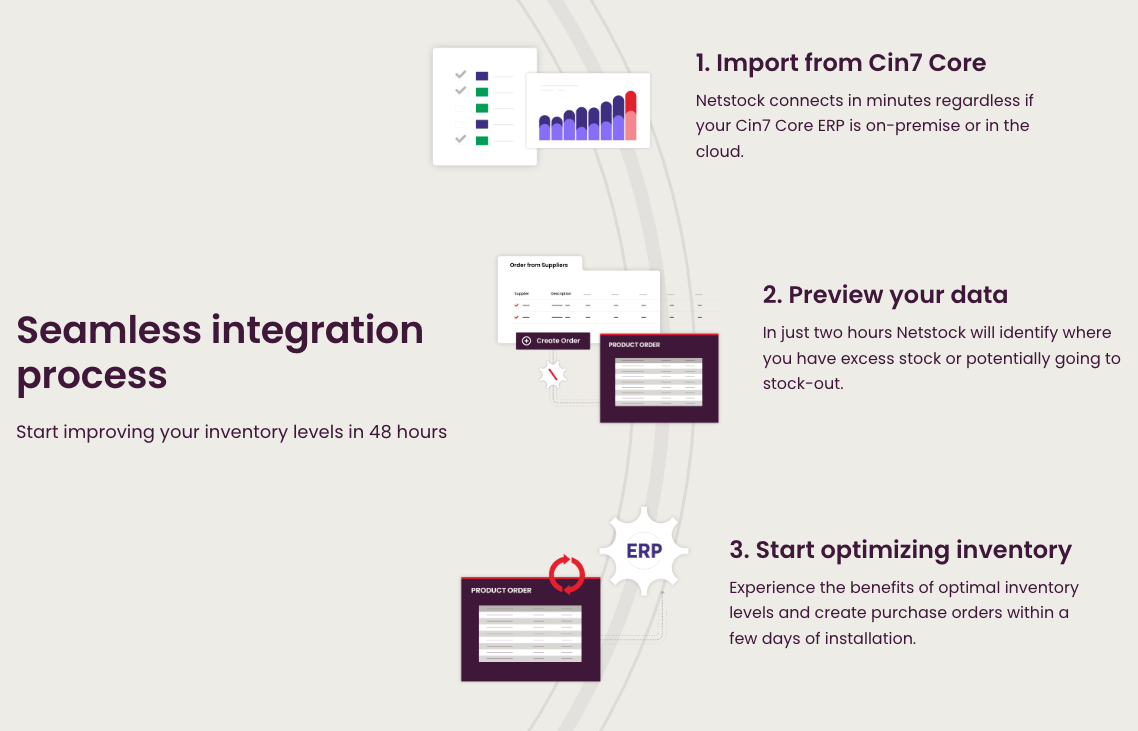
Netstock integrates directly with Cin7 Core through cloud-native APIs that enhance your existing workflows without requiring system replacements or lengthy implementations.
The integration process is designed for minimal disruption:
- Cloud-native connectivity syncs data automatically without manual intervention
- AI-powered forecasting improves accuracy while reducing planning time
- Enhanced service levels through proactive replenishment recommendations
- Optimized cash flow by balancing inventory investment with service requirements
“We were sold when we discovered that it was a cloud-based solution, which made it easy to adopt, and the monthly costs were very attractive as they are based on the value of your stock.” – Christopher Comodikes, Operations & Supply Chain Executive, Pack Leader
Read More
Most retailers see immediate improvements in forecast accuracy and inventory turnover, with ongoing gains as machine learning algorithms adapt to their specific demand patterns. The system grows more valuable over time, learning from your business’s unique seasonal patterns, promotional impacts, and customer behaviors.
Unlike standalone forecasting tools that require separate data management, Netstock works within your existing Cin7 Core environment, enhancing familiar workflows rather than replacing them.
Making the shift to omnichannel resilience
The retail landscape has moved beyond what ERP-only solutions can handle effectively. Customer expectations, channel complexity, and competitive pressure require inventory intelligence that anticipates rather than reacts to market changes.
Integration unlocks the agility that modern omnichannel retail demands: the ability to scale efficiently, respond to demand shifts quickly, and maintain service levels while optimizing working capital. Retailers who make this shift gain operational advantages that compound over time, building the foundation for sustainable growth in increasingly competitive markets.