It’s Monday morning. Your inbox is already filling up. Sales has flagged an unexpected spike in demand. Operations is asking whether incoming purchase orders will arrive on time. Finance wants to know why working capital is tied up in slow-moving stock.
You open your forecasting spreadsheet and pause. The numbers look fine on paper. But the reality on the warehouse floor tells a different story.
If this sounds familiar, you’re not alone.
Inventory forecasting has never been simple. But in today’s environment of shifting demand, supplier variability, and tighter margins, inventory forecasting with gut feel and manual systems is no longer an option. Learning how to forecast inventory accurately is one of the most important skills for inventory planners, supply chain managers, and business owners alike.
At its core, inventory forecasting is the process of using historical demand data, trends, and business insight to predict future sales and determine optimal stock levels. Done well, it helps you reduce stock-outs, avoid excess inventory, and improve profitability. Done poorly, it creates cash flow strain, lost sales, and reactive firefighting.
In this guide, we’ll break down proven inventory forecasting methods, step-by-step techniques, practical activities to improve forecast accuracy, and how modern inventory management software and AI-powered tools simplify the entire process.
What you’ll learn: Key takeaways
If you’re looking for a quick answer, here’s how to forecast inventory effectively:
- Collect historical demand data for each SKU across locations.
- Adjust for seasonality, trends, and promotions that may influence demand.
- Choose an appropriate inventory forecasting method, such as moving averages or trend analysis. Leveraging AI-driven forecasting solutions allows you to combine methods at different levels for enhanced forecasting capabilities.
- Factor in supplier lead times and safety stock to protect against variability.
- Monitor forecast accuracy regularly and adjust based on actual sales performance.
Inventory forecasting isn’t a one-time calculation. It’s a dynamic process that blends historical data, business insight, and structured forecasting techniques to predict future demand and determine optimal stock levels.
1. What is inventory forecasting?
“If you don’t know what you will sell tomorrow, how will you know what to buy today?” – Barry Kukkuk, CTO and Co-founder of Netstock.
That question captures the essence of inventory forecasting.
Inventory forecasting is the process of using historical sales data, demand patterns, lead times, and business insight to predict future product demand and determine the optimal stock levels needed to meet it.
In practical terms, inventory forecasting answers one fundamental question:
What should we buy, and when, to meet demand without tying up unnecessary cash?
For each SKU, inventory planners must make decisions such as:
Questions Every Inventory Planner Should Ask
- How many units should I order?
- How much safety stock is required?
- How often should I reorder?
- What is the reorder level?
- How will minimum order quantities (MOQs) affect future replenishment?
- What inventory will we need in three or six months to maintain or improve fill rates?
These decisions become increasingly complex as product catalogs grow and customer demand fluctuates.
To generate accurate inventory forecasting outputs, planners need access to multiple data points, including:
- Current inventory levels
- Open purchase orders
- Historical sales data
- Supplier lead times
- Customer buying trends and seasonality
- Upcoming promotions or campaigns
- Insights from sales and marketing teams
An integrated inventory management solution centralizes and automates these data inputs, transforming fragmented spreadsheets into structured forecasting workflows.
Accurate inventory forecasting is not just a mathematical exercise. It requires cross-functional collaboration. Regular alignment between sales, marketing, operations, and supply chain teams ensures forecasts reflect real-world changes – from promotional events to supplier variability – improving accuracy and reducing risk.
2. Four main inventory forecasting methods
You must choose forecasting methods that align with your data availability, product lifecycle stage, and demand patterns to build an accurate inventory forecast. Inventory forecasting methods generally fall into two primary categories: qualitative and quantitative.
Qualitative forecasting methods
Qualitative forecasting is used when historical sales data is limited or unavailable, for example, when launching a new product or entering a new market.
Instead of relying purely on past data, this method draws on:
- Sales team insights
- Customer feedback
- Market research
- Expert panels (such as the Delphi method)
- Scenario planning
Qualitative methods are especially useful for new SKUs, promotional launches, and major business shifts. However, because they rely on human judgment, they should eventually transition to data-driven forecasting once enough sales history is available.
Quantitative forecasting methods
Quantitative forecasting uses measurable historical data to project future demand. This approach is ideal for established products with consistent demand patterns.
Common quantitative inventory forecasting techniques include:
- Moving averages: Calculates the average demand over a defined period to smooth fluctuations.
- Exponential smoothing: Weighs recent demand more heavily to respond to changes faster.
- Trend analysis: Identifies upward or downward demand movement over time.
- Regression analysis: Uses statistical relationships between variables (such as promotions or seasonality) to predict future demand.
These techniques allow planners to create structured, repeatable forecasts across hundreds or thousands of SKUs.
Alternative visualization and trend methods
Some planners rely on graphical forecasting to visualize demand trends. While helpful for identifying patterns, visual trend forecasting does not automatically account for seasonality, intermittent demand, or unexpected disruptions.
Trend-based methods can support marketing strategy and promotional planning, but they should not replace structured forecasting models when building an accurate inventory forecast.
Forecasting Method Comparison
| Method Type | Best For | Strength | Limitation |
| Qualitative | New products, limited history | Incorporates expert insight | Subjective, less scalable |
| Moving Average | Stable-demand products | Simple and easy to implement | Slow to react to rapid changes |
| Exponential Smoothing | Products with moderate variability | Adapts to recent demand shifts | Requires parameter tuning |
| Trend Analysis | Identifying growth/decline patterns | Highlights directional change | Doesn’t fully account for seasonality |
| Regression | Complex demand drivers | Captures external variables | More advanced statistical modeling |
Modern planning teams often combine multiple methods inside an advanced inventory management platform to continuously refine forecasts and reduce errors from manual workload.
Case study: Advanced inventory forecasting at work
Shimano North America Bicycle Inc. enhanced production and replenishment for over 60,000 items, achieving agile planning and improved responsiveness to changing customer demand through Netstock’s advanced inventory optimization. Discover how Netstock can revolutionize your inventory management. Sign up for a demo today!
3. Essential activities to improve inventory forecasting
Since each stock item will have its own demand, no sales forecast will be the same. Ideally, you need to independently capture the monthly sales history for each item in each location and perform monthly and weekly activities. However, before you do that, you should first classify your inventory.
Inventory classification
An inventory holding business will typically have hundreds or even thousands of different stock items, and you must identify your high-moving and slow-moving items. A vital step to improving your forecasting process is to classify your inventory to focus on the right stock items that make you the most profit.
When you use ABC analysis to classify your inventory, you’ll immediately know:
- Your fast-moving items,
- Your slow-moving items and,
- What items need to become obsolete or non-stocked?
Monthly forecasting activities
Monthly forecasting is where structure meets strategy. Instead of manually adjusting every SKU, high-performing teams follow a disciplined review process.
Here’s how that process typically unfolds:
1. Generate a system-based baseline forecast
Start by using a forecast engine to create computer-generated forecasts for all SKUs. These forecasts should be based on historical demand patterns, factoring in:
- Trends
- Seasonality
- Intermittent demand
- One-off sales spikes
- Lost sales data
Advanced inventory forecasting tools test multiple algorithms behind the scenes and compare results against historical demand to determine the best fit for each item. This creates reliable baseline forecasts across most of your product portfolio.
2. Review forecast exceptions
No system will produce perfect results for every SKU. A small percentage of items will require manual intervention. Netstock highlights exceptions so you can focus on what matters most when refining inventory forecasts.
Focus on products where:
- Sales consistently exceed forecast
- Sales consistently fall below forecast
- Variability is unusually high
Adjust forecasts upward where demand consistently outpaces expectations. Adjust downward where demand has softened.
The goal is not to override the system unnecessarily. It’s to refine exceptions while preserving automation for the majority of items.
When should you manually adjust a forecast?While automation improves efficiency, manual adjustments are still necessary in certain situations. Consider intervention when:
- A new SKU has no historical sales data
- A product replaces an older SKU and requires linked history
- A major customer is gained or lost
- A promotion, pricing change, or event will significantly alter demand
- External disruptions impact supply or buying behavior
Manual intervention should be exception-based – not the default. The goal is to refine edge cases while allowing structured forecasting models to handle the majority of items.
3. Account for customer changes
As soon as you become aware of customer shifts, adjust forecasts accordingly:
- Subtract the expected monthly demand from lost customers
- Add projected demand from new customers
For new products without historical data, apply manual forecasts for the first few months. If the new item replaces an older SKU, link it to the original product so historical sales data can inform early forecasting decisions. This accelerates the accuracy of safety stock and improves confidence in early-stage planning.
4. Adjust for promotions and planned events
Promotional campaigns, pricing changes, and marketing pushes can significantly alter demand.
Incorporate cross-functional input to layer expected promotional demand on top of regular sales patterns. Strong communication between sales, marketing, and supply chain teams increases forecast accuracy and reduces post-promotion excess inventory.
5. Measure forecast performance and bias
Track forecasting performance by comparing:
- System-generated forecasts
- Manually adjusted forecasts
- Actual sales performance
Measure both accuracy and bias (over-forecasting versus under-forecasting). This analysis reveals whether manual intervention improves outcomes or introduces unnecessary volatility.
6. Conduct a macro-level sanity check
After making SKU-level adjustments, zoom out.
Review total sales versus total forecast at a macro level to confirm that projected growth aligns with business expectations. If overall projections appear too aggressive or too conservative, apply controlled macro adjustments.
Structured monthly forecasting reviews reduce the risk of excess inventory, improve service levels, and strengthen working capital performance.
Weekly forecasting activities
Weekly activities highlight exceptions between the pro-rated forecast and the actual sales. Here, any severe deviations between sales and pro-rated forecasts highlight potential issues with the forecast for individual items. Reviewing these alerts enables a prompt response to possible changes in demand.
Review forecasts for the top 5-10 sales versus forecast exceptions:
- Increase your forecast – if you are selling more
- Reduce your forecast – if you are selling less
- Consider that you may be selling less due to stock-outs
Why manual forecasting breaks down at scale
The steps above outline a structured approach to forecasting inventory. On paper, the process makes sense.
But now consider what happens when you manage:
- Hundreds or thousands of SKUs
- Multiple warehouse locations
- Variable supplier lead time
- Promotional calendars
- Intermittent demand patterns
- Shifting customer behavior
Suddenly, what looks manageable in a spreadsheet becomes overwhelming.
Manual forecasting introduces risk in two ways:
- Time constraints: By the time planners update spreadsheets and review exceptions, demand conditions may have already shifted.
- Human bias: Manual overrides can unintentionally introduce optimism or conservatism, distorting long-term accuracy.
This is where modern AI inventory management tools make a measurable difference.
Instead of relying on static formulas, AI-driven forecasting continuously analyzes demand signals, recalibrates models, and automatically identifies exceptions. It reduces manual workload while increasing forecast responsiveness and accuracy.
Rather than replacing planners, AI enhances their ability to focus on strategic decisions instead of spreadsheet maintenance.
When combined with a structured inventory process, technology turns forecasting from a reactive, mathematical exercise into a proactive growth enablement process.
4. Benefits of an effective forecasting process
It’s a common belief that if your forecast is spot-on, your supply chain will run smoothly, but that’s not always the case. Unfortunately, no forecasting system is perfect. There will always be some bumps along the way.
Just importing data from your ERP into a spreadsheet won’t give you an accurate forecast. Sure, Excel has some forecasting formulas, but they’re built for small, simple data sets. They’re not equipped to handle hundreds or thousands of items. Plus, by the time you update everything, the data could be outdated. That’s a perfect recipe for errors.
The key to better forecasting?
To stay competitive, invest in inventory and demand planning solutions that unlock the data in your ERP, providing the visibility needed to create accurate sales forecasts that take seasonality, trends, and potential problem areas into account.
When you have a structured process, facilitated by purpose-built technology in place, you’ll start to see improvements in your forecast:
- Happy customers: Who receive the right items on time and in full
- Reduced stock-outs: You won’t miss out on any potential sales
- Less safety stock: Your order recommendations will be accurate
- Fewer slow-moving items and less obsolete stock: You won’t order more of these items and unnecessarily tie up cash by classifying your less important stock items
- A focused sales strategy: Accurate forecasts are useful for sales and marketing when planning their promotional campaigns
See how modern inventory forecasting works in practice
Understanding how to forecast inventory is one thing. Seeing how structured forecasting works in a real system is another.
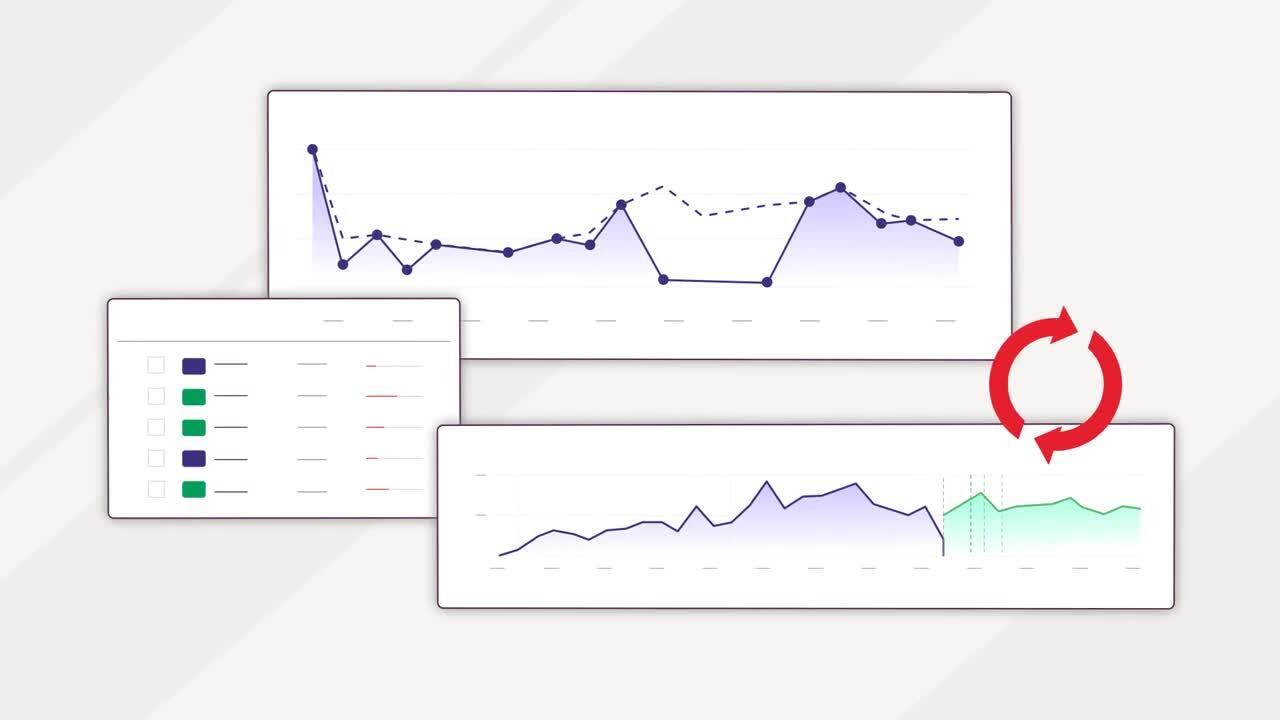
In the short overview below, you’ll see how Netstock transforms historical sales data, supplier lead times, seasonality, and demand variability into a practical, actionable forecast. Instead of manually adjusting spreadsheets, planners gain visibility into exceptions, risk areas, and recommended order quantities in one place.
This walkthrough shows how AI-powered forecasting supports better decisions without replacing the planner’s expertise.
If you want to explore how this approach applies to your business, you can learn more about Netstock’s inventory forecasting solutions below.